Lisbon 2025
- 2 hours ago
- 14 min read
Study Conference in Portugal, November 23rd – 30th

It was exceptionally beautiful winter weather at home when we set off just after noon. The sun was low in the sky, offering a crystal-clear view from Reykjanes peninsula over the mountains Esja, Akrafjall, and Hafnarfjall and the Snaefellsnes peninsula. The sun was setting in the west when the plane took off around four o'clock. My wife and I were on our way to Lisbon, the capital of Portugal. The spark for the trip was an invitation I received to a study conference hosted by the English Matters organization. Guðrún joined me on the journey, as we planned to explore the city together once the educational portion of the trip was over. Even though it was technically the "cold season" in Lisbon, the weather forecast for our stay looked promising - a welcome extension of summer lay ahead. While light showers were predicted for the first day, the rest of the week was expected to be sunny with temperatures around 17°C.

One would naturally expect plenty of notable sights in the second oldest city in Europe—only Athens is older. The city itself has a population of about 570,000, but the Greater Lisbon area is home to three million people. We stayed at the Hotel Melia Oriente, a four-star hotel located just over seven kilometers from the city center. Accessing the metro was very easy, so the distance from downtown didn't bother us at all. It was also a great bonus that the Vasco da Gama shopping center was only a few minutes away. We fully intended to take advantage of that and do some shopping, as the price levels in Lisbon are much more favorable than in our beloved Reykjavik.
The Study Conference
My first day began with an introduction to the Portuguese school system in the hotel's Expo hall. After five hundred slides, I was left feeling half-dazed due to the lack of air and sheer information overload. Nevertheless, I managed to gather that the school system is divided into pre-school for children aged three to six, and compulsory education for students from age six to eighteen. This compulsory period is split into primary and secondary education, with the primary level further divided into three cycles.
The first cycle is for students in grades 1–4. Each class has a single teacher who teaches all subjects. The primary focus is on the Portuguese, social studies, mathematics, and English. Occasionally, a specialized teacher comes in to teach subjects such as the arts.
The second cycle is for students in grades 5 and 6. At this stage, subject-specific teaching begins, and subjects like geography, history, and science are added to the curriculum.
The third cycle covers grades 7–9. In this phase, subjects such as physics, chemistry, and a third language are introduced.
Secondary school (high school) is for students in grades 10–12. During these years, students can specialize according to their interests. There are three main tracks to choose from: Sciences and Humanities, Vocational training, and the Arts.
Schools in Portugal are either state-run (public) or private. Education in public schools is free of charge, although parents pay between 30 and 50 euros per month (approximately 4,200–7,200 ISK) for school meals. Tuition for private schools ranges from 60,000 to 80,000 ISK per month, with meal costs added on top of that.
One thing I find particularly interesting is that parent-teacher conferences are rare in the Portuguese school system. If a student faces specific issues, parents are referred directly to a psychologist and/or a social worker. The school appears to focus primarily on academics and instruction, leaving health and welfare matters to the systems they actually belong to. The reason I find this so striking is that I encountered a similar approach in the Netherlands a two years ago. Back home, administrators and teachers are "drowning" in meetings involving parents and welfare professionals, where the discussion is often centered on health or social issues rather than education and pedagogy. I have become quite skeptical about whether we are on the right track in this regard, and I would much rather see teachers' time dedicated to the planning and development of their instruction.
The ventilation system in the Expo Hall must have been adjusted, as the next part of the conference was much more tolerable. It was no longer necessary to "breathe with a knife and fork" just to get some oxygen. An entire morning was dedicated to group discussions, analyzing what we had learned so far and asking further questions about the Portuguese school system. These discussions provided a valuable opportunity to compare notes and discuss the challenges our respective countries are facing. Such exchanges are always beneficial.

The third day began with a bus trip to Atlantica School. It is a massive institution with 1,700 students, ranging from toddlers in diapers to 18-year-olds completing their compulsory education.
While visiting such a large school was certainly interesting, I can't say that much of it really stuck with me. Perhaps I’ve simply visited too many schools over the years, and there wasn't anything that particularly caught my eye—well, except maybe for the messy toilets and a massive greenhouse.
History and Culture
Praca dos Resturadores
School matters were not the only things English Matters provided insight into. On Monday afternoon, we were invited on a guided walking tour of the city center. We met the entire conference group by the statue at Praça dos Restauradores, and from there, we marched off behind our guide—a delightful elderly woman. The square and its monument commemorate the restoration of Portugal's independence from Spain. Gaining that independence was no easy feat; the uprising began in 1640, and sovereignty wasn't secured until 28 years later, in 1668. Information like this flowed like a river in a spring flood from this knowledgeable woman. I only managed to catch a fraction of everything she said. The "cherry on top" was supposed to be the view over Lisbon's city center from Portas do Sol. To get there, we first had to climb the steep street where the famous Tram 28 had recently careened down with tragic consequences, resulting in sixteen fatalities. As it turned out, the view was practically non-existent due to heavy rain. Once we parted ways with the guide, we ended the day at the Rossio Christmas Market, where we treated ourselves to cake, coffee, waffles, and beer. Our knowledgeable guide had told us that the market stands on an area that used to be on the outskirts of the city, where visitors would leave their horses.




Left image: Restoration Square (Praça dos Restauradores). This is where we stood, waiting for the walking group in the pouring rain.
Right image: The steep hill where the tram careened down. Once at the top, there was a great view of the city to the right.
An Evening of Fado in Bairro Alto
On Tuesday evening, English Matters invited us to dinner at the Adega Machado restaurant in the Bairro Alto district. The restaurant opened its doors in 1937, so it is certainly not a new establishment. The menu is said to be traditional. I can't say we remember the food all that clearly, but the service was excellent, and it was particularly enjoyable to hear Fado music performed between courses. Since the meal was hosted by English Matters, we have no idea whether it was expensive or not—likely much more so than a standard dinner, which is expected given the live music.
Fado music could perhaps be described as Portuguese blues. This refers mainly to the lyrics, which are characterized by resignation, melancholy fate, and longing (saudade). The music itself, however, is nothing like the blues. It is performed by a singer, a classical guitar, and a Portuguese guitar, along with an acoustic bass, often a double bass. The verses often alternate between major and minor keys, and the rhythm is frequently in double or triple time, similar to a waltz. Rubato is commonly used to give the music its emotional depth; while the bass keeps a steady beat, the singer plays with stretching the tempo at the end of phrases to heighten the drama.

The origins of this musical genre have been traced back to the Bairro Alto, Mouraria, and Alfama districts of Lisbon, specifically to the years 1820–1830. The performers came primarily from the working class. Sailors, courtesans, bohemians, and impoverished artists performed the music and danced along in the local taverns. As with most things that evolve gradually, like Fado has, it is difficult to pinpoint exactly when it could officially be called a musical genre. Its roots, undoubtedly, reach much deeper than that.
Quinta da Regaleira
In the afternoon of the day we visited Atlantica School, we were driven to the town of Sintra, where we wandered through "some garden" with old buildings. I say "some garden" because that was the feeling I got as we followed the guide through the grounds. I hadn't found the time to research what I was actually looking at, which is probably why I didn't enjoy the tour as much as I could have. Furthermore, I must admit that following a guide in a large group, struggling to catch the information they rattle off, is simply a situation that doesn't suit me. Be that as it may, the estate is called Quinta da Regaleira. The site features an ornate palace, a chapel, wells, and a garden thick with trees and winding paths. Personally, I found the history of the palace and the area rather uninteresting, as I couldn't shake the impression that this was merely a playground for the wealthy. That being said, it was beautiful there, and the 27-meter deep "Initiation Well" was intriguing—though the purpose of building a waterless well deep into the ground remains a mystery to me.
This concluded the mandatory part of my itinerary, and from then on, Guðrún and I had the rest of our time to ourselves. We spent that time exploring this ancient city and doing some shopping. And yes, there is plenty of reason to shop in Lisbon, as the prices are far more favorable than back home in Iceland.




Image on the left: The chapel and the small palace.
Image on the right: The Initiation Well. It seems a strange whim to waste money on constructing this 27-meter deep well.
Vasco da Gama Tower and the Bridge
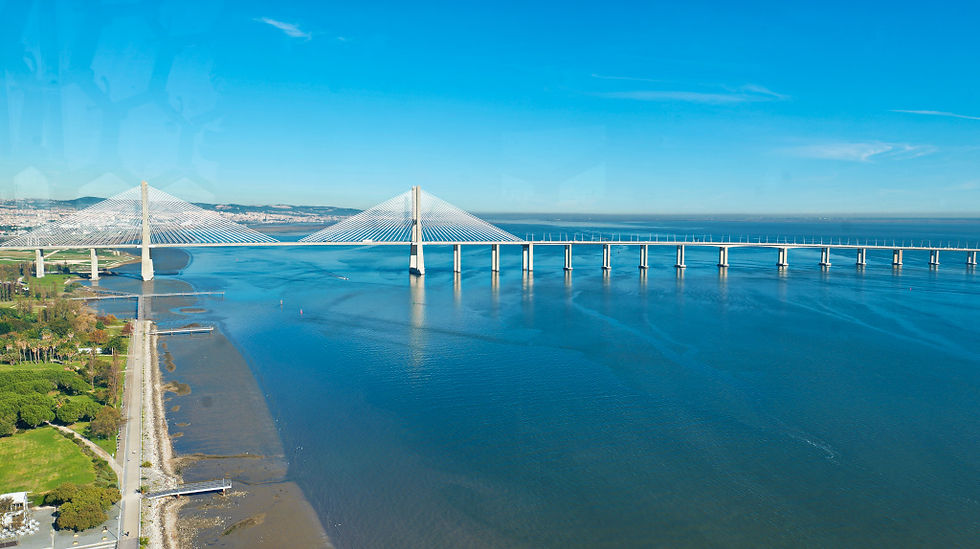
Not far from our hotel, down by the Tagus River, stands the Vasco da Gama Tower. The Portuguese have a notable history of exploration, and the tower bears the name of their most famous explorer, Vasco da Gama, who charted the sea route from Europe to India. The tower was built for the 1998 World Expo. It rises proudly to 160 meters, making it the tallest building in Portugal. After the Expo, a new purpose had to be found for the tower. Initially, the plan was to lease it out as office space, but that failed as there were no takers. Today, the tower serves as a hotel. The very first thing Guðrún and I did after I was finished with my mandatory conference duties was to go up the tower to look out over the city. It wasn't necessarily because we found the tower itself particularly remarkable—it was more likely because it was within walking distance of our hotel and served as the first stop for the Hop-on Hop-off bus, for which we bought 24-hour passes to get a feel for the city.
From the top of the tower, one could see a massive structure that was also inaugurated in 1998, just before the World Expo. Like the tower, the bridge was named after Vasco da Gama to commemorate the 500th anniversary of his achievements. Spanning 13 kilometers, it is the longest bridge in Europe. The bridge is exceptionally robust, as it is located in a well-known earthquake prone area. It is designed to withstand wind speeds of up to 250 km/h and is built to last for 120 years. I must say, it is a truly magnificent feat of engineering.
Torre de Belém o Padrao dos Descubrimentos
There is plenty worth seeing in the Belém district, located in the western part of Lisbon. To get there, we took bus number 728 from the Gare do Oriente station. Ideally, one would hop off the bus at the Belém Tower, stroll east toward the monument, and then head north to the monastery. We didn't do that, however, because the tower was closed and shrouded in scaffolding during our visit. Instead, we got off at the monument and viewed the tower from a distance. The tower was built between 1514 and 1519 at the behest of King Manuel I of Portugal. Its purpose was to strengthen Lisbon's defenses and control ship traffic on the Tagus River. During the years of its construction, the Portuguese were beginning their Age of Discovery. In later years, the tower also served as a prison and as a lighthouse for mariners.

Slightly further east on the north bank of the Tagus River stands the Padrão dos Descobrimentos, or the Monument to the Discoveries. It was cast in concrete in 1960 to commemorate the 500th anniversary of the death of Prince Henry the Navigator (Dom Henrique), who was the first major figure of the Portuguese Age of Discovery. He stands at the very prow of the monument, followed by 32 prominent figures from that era. As we were wandering around the monument, I was stopped by a group of students working on a school project about the tourism industry in Portugal. They wanted to know what I found most remarkable about Lisbon so far. I couldn't think of anything more fitting to say than the friendliness of the people and the excellent food.
Jerónimos Monastery

We walked across the street from the monument toward this magnificent structure. It reportedly stands on the exact spot where Vasco da Gama and his crew knelt in prayer before setting sail for India. The monastery was built during the same period as the Belém Tower. Previously, a church dedicated to Saint Mary of Belém stood on the site, and a statue of her remains positioned above the monastery's entrance. Towering over everything is a statue of Archangel Michael. We only viewed this stunning building from the outside, and to be honest, I regret choosing to visit the Maritime Museum at the end of the building instead of the monastery museum itself.
The Maritime Museum
On our day before the last day in Lisbon, we made another trip to the Belém district, this time to visit the Maritime Museum. We chose it because of Portugal's remarkable seafaring history. We somewhat regret that choice, as the museum is essentially an endless collection of various ship models. One would have thought that such a significant history could be presented in a better and more engaging way than this.
Praca do Rossio
Rossio Square is officially named Praça de D. Pedro IV, whose statue towers 27 meters above the square. Dom Pedro is known as "The Soldier King." Born in Lisbon, he fled with his family to Brazil following the French invasion in 1807. While his father returned to Portugal in 1821, Pedro remained in Brazil. He supported the rebels in the Brazilian struggle for independence and served as the Emperor of Brazil from 1822 to 1831, as well as the King of Portugal in 1826.
Rossio Square became an important gathering place in the 13th and 14th centuries and thus has a long history. The term Rossio refers to the common people, so the name could be translated as "The People’s Square." Originally, the square served as a meeting point for the public as the city expanded outward from the castle area. In 1450, the Estaus Palace was built at the far end of the square to house dignitaries visiting Lisbon. The knowledgeable guide from our walking tour mentioned that visitors' horses were kept on the square. When that horrific institution, the Portuguese Inquisition, was established in 1536, the palace became its headquarters, and the square was frequently used for public executions. The buildings surrounding the square mostly collapsed in the Great Earthquake of 1755. The Estaus Palace was rebuilt, only to burn down later in 1836. Another notable building located at Rossio Square was the Royal All Saints Hospital (Hospital Real de Todos os Santos), which was completed in 1504.
We passed through Rossio Square several times during our wanderings around Lisbon. The buildings we saw were, of course, the reconstructions built in the aftermath of the great earthquake. Otherwise, we didn't get to see the square in all its glory, as it remains the city's primary gathering place. Every year, a Christmas market is set up there, so the square was completely covered in market stalls.


Image on the left: The square was covered in market stalls for Christmas during our visit.
Image on the right: Rossio Square is undeniably beautiful. There are fountains at either end, and the square itself is paved in a wave pattern with black and white stones.
Parque de Eduardo VII

One day, we hopped off the bus at one of the city's highest points—the top of Edward VII Park. This park was once called Liberty Park, but in 1903, a British King visited, and the name was changed. Clearly, the Portuguese felt it necessary to stay on the good side of the British. The view from the fountain at the top of the hill was fantastic, looking south over the Marquis of Pombal Square and all the way down to the Tagus River. We strolled down the slope, passing through a Christmas market that was being set up.
In the center of the square stands a massive statue of the Marquis of Pombal atop a column. He was the Prime Minister to King Joseph I of Portugal. The King gave him free rein, allowing him to become the most powerful man in Portugal. By all accounts, the man was a complete scoundrel, but it cannot be denied that he was exceptionally proactive and brought about many improvements for the country.
He is best known for organizing and driving the reconstruction of Lisbon after the devastating earthquake that struck on November 1, 1755. It was a horrific quake; while its exact magnitude is unclear, it is estimated at around 8.5 - 9 on the Richter scale, and in its wake, Lisbon was left in near-total ruins. Eighty-five percent of all buildings in the city either collapsed, burned, or were claimed by the tsunami. It is estimated that 30,000 to 40,000 people died out of a population of 200,000. When asked "What do we do now?", Pombal famously replied with ice-cold realism: "We bury the dead and heal the living." With that, the reconstruction began in earnest, and this time, the buildings were designed with earthquake safety in mind.
Praca do Comércio

By the Tagus River, there is a massive square located where the Ribeira Royal Palace once stood. That palace collapsed completely during the earthquake, like all the other buildings in the area, necessitating a total reconstruction of the site. Today, Portugal's main government institutions are situated around the square.
In the center stands a grand statue of King Joseph I, who was the King of Portugal when the great earthquake struck. He was incredibly lucky that day because his daughter had requested that the royal family stay at their summer residence—a palace in the Belém district on the outskirts of the city. Poor Joseph was quite shaken by the ordeal and preferred living in a tent afterward, which he actually did. This is likely the reason why the Ribeira Palace was never rebuilt. Behind the statue of Joseph is the Arco da Rua Augusta, or the Triumphal Arch. If you walk under the arch, you enter Rua Augusta, and if you follow that street to its end, you find yourself back at Rossio Square.

We stumbled upon Praça do Comércio while searching for the cathedral. That search ended up in total chaos because the navigation system sent us on a bus that took us all the way up to the "Breiðholt" of Lisbon! We eventually sorted out that mess by ordering a taxi to take us back to the city center. In the end, we found the cathedral—which turned out to be just up the hill, a very short distance from the square. The Lisbon Cathedral (Sé de Lisboa) was built in 1147, so its history spans well over 800 years. Its appearance is very medieval, reminiscent of a fortress from the Middle Ages. Naturally, additions have been made over the centuries, and extensive repairs have been necessary due to earthquake damage. The 1755 earthquake was the largest, but by no means the only one to strike the city.

Comments