In the middle of the Atlantic Ocean, two sparsely populated island nations are not entirely unrelated. The islands were settled around the same time when frustrated Norwegians sailed across the ocean in the ninth century to escape the annoyances of the Norwegian king. These Vikings stopped at the British Isles and brought back British women, forcibly or voluntarily. Therefore, both nations are descendants of Norsemen and Celts. The Vikings brought livestock with them, but, not to disparage other domestic animals, it was the sheep that kept the inhabitants of these lands alive, and the sea, of course, also provided. Recent chromosome studies of Icelanders indicate that over 80% of Icelandic men are descended from Norwegians, as are over half of Icelandic women. It is not unlikely that a similar story can be told of the Faroese. However, new studies suggest that the Faroese can, to a greater extent than Icelanders, trace their ancestry to Swedes and Danes as well.
The languages spoken by the nations are of West Norse origin and closely related. Icelanders find Faroese written language easy to understand, but understanding the spoken language is somewhat more difficult. The reason is the pronunciation. The sound for ‘r’ in Icelandic is rolled, but it is fronted and voiced in Faroese, similar to English. Dental fricatives like the sounds for the letters ‘þ’ and ‘ð’ do not exist in Faroese. Also, various aspects of the grammar have simplified in Faroese. Verb conjugations are simpler, the genitive case is little used, and the nominative and accusative are always the same in the plural, to name a few examples.
It would be a sin and a shame not to cultivate such a close relationship, and therefore Guðrún and I took a trip to the Faroe Islands this autumn in the company of Guðrún’s brother, Siggi, and his wife, Kristbjörg. Guðrún and I set off from Reykjavík after work on Thursday, October 8th, in excellent traveling weather. We had, however, taken precautions and bought new studded tires for the trip, even though it was three weeks until legal tire change day. That certainly proved to be useful because when we arrived at the sign that gives weather reports for Öxnadalsheiði, it just said “closed.” There was freezing rain and a blizzard on the heath. The heath was mainly blocked due to cars that were not well enough equipped for winter conditions. We ventured onto the heath anyway, believing ourselves well-equipped, and we got across without any problems. We stayed in Tónatröð with Siggi and Kristbjörg for the night. The next day, we drove to Seyðisfjörður, where the ferry Norræna docks. We planned to sail to the Faroe Islands on it.
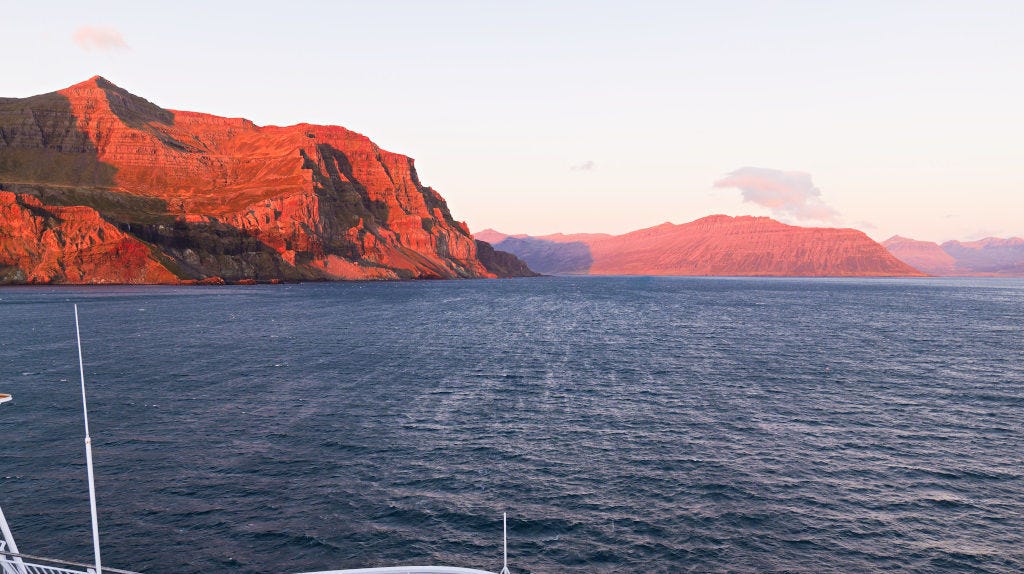
The sailing was uneventful. A bit of rolling and a maximum wave height of six meters. Fortunately, we did not feel sea-sick and could well enjoy having nothing to do for the twenty hours the voyage took. Finally, the islands rose steeply out of the sea. We then sailed in between the islands and finally docked in Tórshavn, the capital of the Faroe Islands. The hotel we stayed at is called Hotel Hafnia. Hotel Hafnia is a decent hotel in a good location in the center of Tórshavn.
We could do as we pleased out there because Siggi’s car was along. It cannot be said that the Faroe Islands surprised us. Many things are similar to home in Iceland. The landscape is all steep down to the sea. Towns and villages sit on the mountain slopes. I couldn’t help thinking about the avalanche danger back home where these conditions exist. I do not remember news from the Faroe Islands about avalanches or mudslides. The climate is clearly different in the Faroe Islands than in Iceland. It does not freeze often, and snow rarely comes. However, it rains on about 270 days a year. We got to know Faroese weather, as it was foggy and raining all the days we were in the Faroe Islands. This great wetness does not, however, seem to be enough to cause loss of life due to mudslides. Avalanches are not a problem in the Faroe Islands either. It is hard to say that snow sticks on the islands.
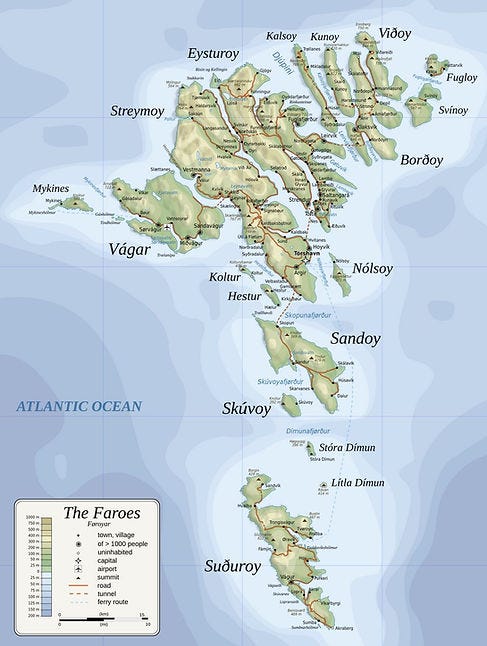
While Icelanders argue about road tunnels, the Faroese dig tunnels. That is presumably the reason why there are 21 tunnels in the Faroe Islands, compared to 12 in Iceland. Previously, the islands were connected by ferry voyages until the Faroese learned about the Hvalfjörður tunnel and saw that tunnels were the way to improve transportation. They get started, while we haggle, argue, and fight. We make plans, approve plans, write reports, research, ponder, and revise plans, but we don't act. The first place we explored in the Faroe Islands was Sandoy. To get there, we drove through Sandeyjargöng, the newest Faroese inter-island tunnel. Sandeyjargöng were opened in 2023 and are just under 11 kilometers long.
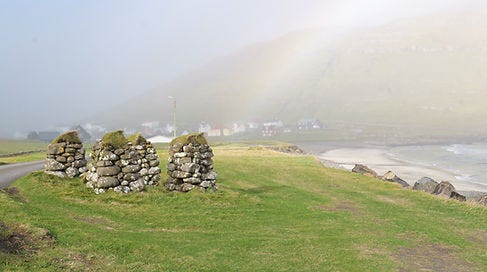
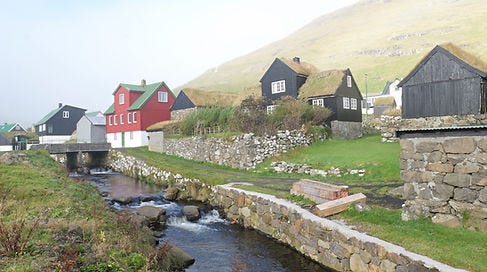
Over 1300 people live on Sandoy. The largest town is Sandur, where there are about 660 inhabitants. We didn't stop there, but drove towards Húsavík. On the way there, we saw many cars parked by the road and people walking. "There must be some festival here," we said and continued our journey until the road ended in a tiny, beautiful village on the eastern side of Sandoy. 70 inhabitants live in the village. There were many stone-walled houses in the village and stone walls and fences everywhere. We were to see this all over the islands. Probably the Faroese find it easier to maintain the stone walls than we Icelanders do, because of the weather. Very often, wooden houses were built on top of the stone walls, with turf on the roof.
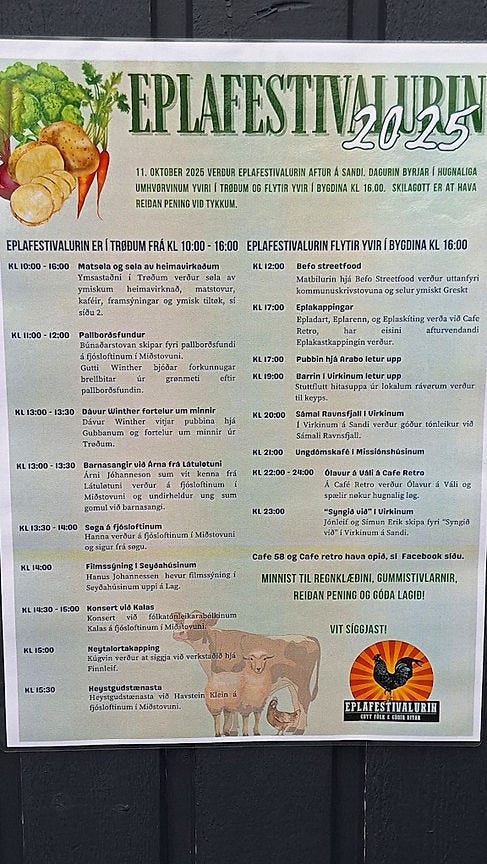
By the time we came back, the number of people by the road had increased, so we decided to find out what was going on. We followed the people in along the country road. This turned out to be the Eplafestivalin in Tröð. Eplafest is a potato festival, not an apple festival, and the occasion was the potato harvest. At the festival, you saw little phone-staring, and the children weren’t munching on candy like at all festivals back home. Their candy was apples that had been sugared. The weather this first day in the Faroe Islands was exactly as expected. It was wet, temperature 11–13 degrees. One moment the mountains were visible, the sun was shining, and a rainbow framed the landscape. The next moment, it was thick fog, and visibility was minimal.
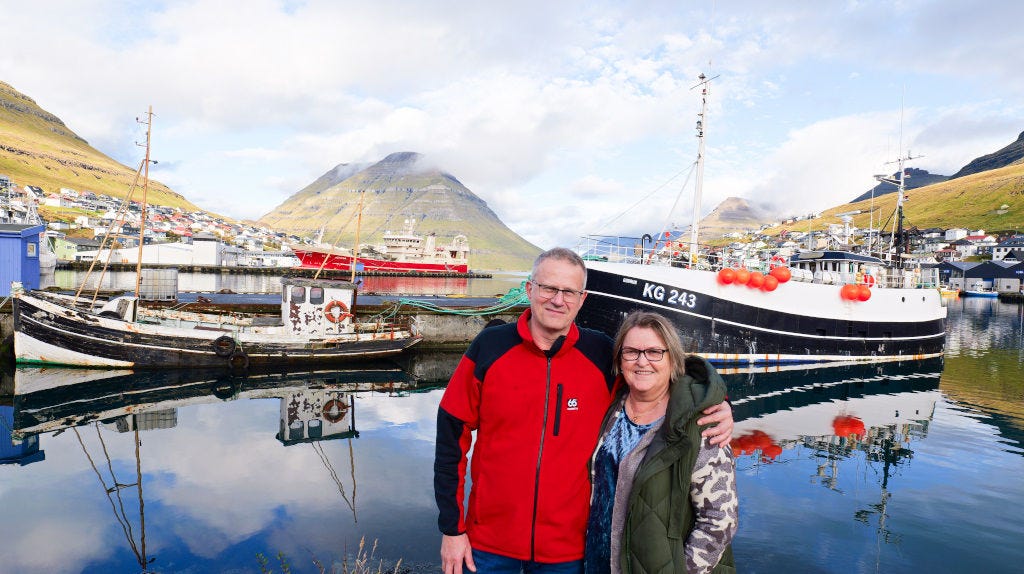
The next morning, after a rich breakfast at Hotel Hafnia, we drove northeast to Eysturoy. Bowed down in shame for the second day in a row over the lack of action and argumentative nature of Icelanders, we drove through a recently built tunnel between Streymoy and Eysturoy. The first stop was in Norðragöta, where we stumbled upon a statue of the most famous Faroese person ever, Þrándur í Götu. The journey continued to Klakksvík, the second-largest town in the Faroe Islands. Another Faroese person well-known to Icelanders lived there, singer Jógvan Hansen. Klakksvík is a fishing village of five thousand people. We didn’t find much of note to see in the town but enjoyed walking the path along the new nursing home and admiring the boats and the buildings bathing in the sun, which shone brightly there that morning.
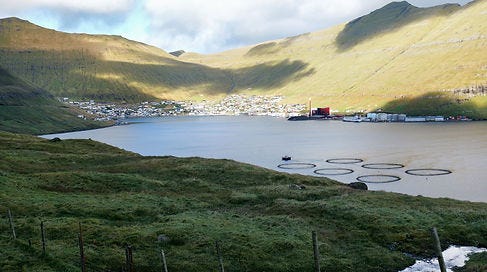
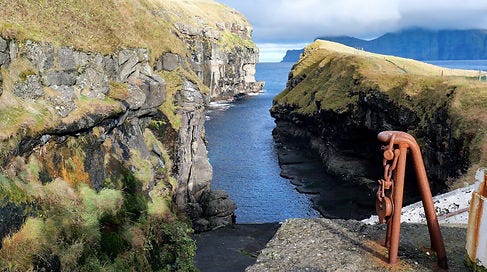
Fuglafjörður was our next destination. The village in Fuglafjörður is reasonably populated. About 1600 people live there. The village sits at the bottom of the fjord and is surrounded by high mountains on all sides. Yet, it enjoys sun year-round. From Fuglafjörður, we drove over a considerable mountain road to Gjógv. The road was, of course, paved with numerous passing bays, so the driving was not considered difficult for an Icelander accustomed to other and worse conditions. The town is first mentioned in records in 1584, but it is known that people lived there long before that time. The livelihood of the villagers was fish that was dried, salted, and sold. In short, saltfiskur in Icelandic, but klippfiskur in Faroese. The entrance to the harbor is absolutely amazing. The boats sail along a two-hundred-meter-long gorge, and then they have to be pulled onto dry land at the innermost part of the gorge. Today, only 19 people live in the village, but in the past, 13 boats were operated from the village, and the inhabitants numbered over 200. We Icelanders know all too well that the sea gives and the sea takes. Not far from the church is a monument to those who were lost at sea. A mother sits there with her two children, looking out to sea. There, one could see that the gorge that created such a good entrance also took its toll.
The church in Kirkjubøur is called Ólafskirkja. It still serves as a parish church and has done so since it was built in 1111. Actually, there is hardly anything left of the original church. Ólafskirkja served as the cathedral of the Faroese in Catholic times. Around 1300, construction began on Magnúsarkirkja, which is now called Múrinn (The Wall). Its walls still stand and are testament to great ambition, as this was one of the most magnificent churches in the Nordic countries. There is some debate about whether Magnúsarkirkja was ever completed. Its remains are colloquially called Múrinn.
Næsti áfangastaður var helsti sögustaður Færeyinga, Kirkjubær. Kirkjubær er lítið þorp á suðvestanverðri Straumey. Þorpið var áður stærra. Sagan segir að flestum húsanna hafi skolað á haf út í ofviðri á 16. öld. Þarna var biskupssetur frá tólftu öld og fram að siðaskiptum á sextándu öld en þá tók Paturssonfjölskyldan við búskap á jörðinni og nú býr sautjánda kynslóð fjölskyldunnar í húsinu. Elsti hluti íbúðarhússins er frá elleftu öld og er því elsta timburhús í heimi þar sem enn er búið í.
Kirkjan í Kirkjubæ ber heitið Ólafskirkja. Hún þjónar enn sem sóknarkirkja og hefur svo verið frá því hún var byggð árið 1.111. Reyndar er varla nokkuð eftir af upphaflegu kirkjunni. Ólafskirkja gegndi hlutverki dómkirkju Færeyinga í kaþólskum sið. Um 1300 var hafist handa við að byggja Magnúsarkirkju sem nú er kölluð Múrinn. Veggir hennar standa enn og eru til vitnis um mikinn stórhug því þetta var ein veglegasta kirkja á Norðurlöndum. Einhver áhöld eru um hvort Magnúsarkirkja hafi einhvern tímann verið kláruð. Leifar hennar eru í daglegu tali kallaðar Múrinn.


Guðrún had arranged to book dinner for us at Angus Steakhouse in the center of Tórshavn. We had, of course, beef steak with whiskey sauce. The steak was expensive, but good too.
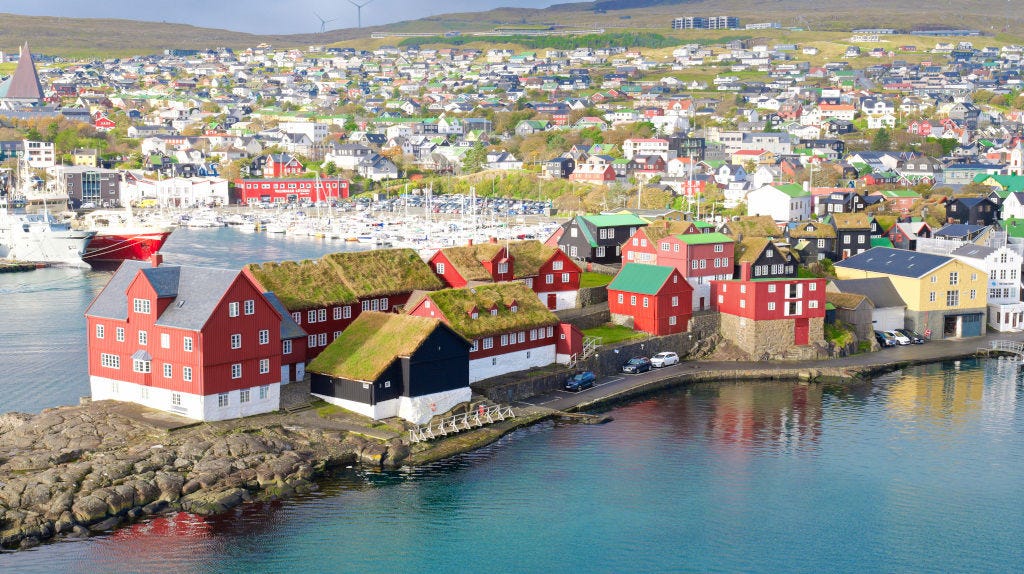
We had decided to start the last day in the Faroe Islands in Gásadalur and finish this trip by exploring the capital. The fog proved to be extremely thick, so we unfortunately had to cancel the trip to Gásadalur. Instead, we went to the Nordic House and had coffee there. Next, we strolled around Tinganes. Along with Þingvellir and Tynwald Hill on the Isle of Man, Tinganes is the oldest parliamentary site in the world. The Vikings met there around 900 and made their decisions. To this day, the Faroese government is located on the point. We strolled around Tinganes at a leisurely pace. We stumbled upon the Icelandic Consulate General and popped in. There, we met a woman I recognized very well but couldn't for the life of me figure out from where. I've figured it out now.
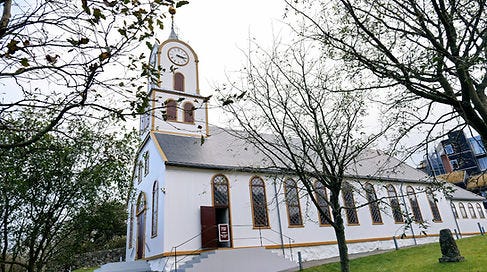
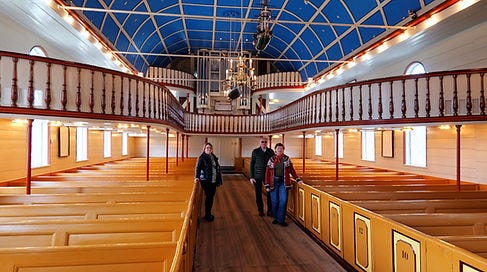
The city center is not large in Tórshavn, even though 25% of the Faroe Islands' inhabitants live there. In fact, only just over 56 thousand people live in the Faroe Islands, and just over 14 thousand in the capital, Tórshavn. On this stroll around the center, we made a bathroom stop at the hotel. We went out through the back door on the first floor and ended up in the backyard of the cathedral. Then it was of course, nothing left to do but explore it. Inside, we met a retired high school teacher. He taught us about quite a few things related to the church’s history. When he heard the language we spoke among ourselves, he realized we were from Iceland. Then, of course, talk turned to the connection between Iceland and the Faroe Islands. We named well-known Faroese people in Iceland. Among them, Eivör. Then it turned out that the high school teacher’s wife was an opera singer who arranged for Eivör to study singing with Ólöf Kolbrún, an opera singer and wife of Jón Stefánsson, the organist at Langholtskirkja. On our travels around the islands, we had stopped in Syðrugøta, Eivör’s hometown, where the aforementioned Þrándur í Götu lived.
The final meal was then eaten at the Áarstova restaurant at Gongin 1 in Tórshavn. The dish we had was Áarstovubógvur with root vegetables and sauce. That is, slow-cooked lamb shoulder.
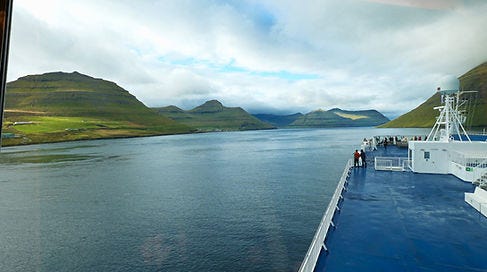
Norræna docked in Seyðisfjörður around nine o’clock in the morning, which was extremely convenient because then we had the whole day to get home. We made one stop on the way at the Beitahúsið in Möðrudalsöræfi.