Flatey in Breiðafjörður, July 10th - 17th, 2020
Hopefully we will see Red-necked Phalarope

The Government Employees' Association owns summer houses in four locations around the country. This must be considered quite good, considering there are only about 250 members. The houses are located in Akureyri, Munaðarnes in Borgarfjörður, Brekkuskógur in Biskupstungur, and Flatey. Guðrún and I have utilized all these houses except for the one in Flatey. Now, it was time. Guðrún and her colleague, Anna María, agreed to stay together in the Flatey house during their summer vacation. Jóhann, Anna María's husband, and I accompanied them as part of the women's agreement.

The trip began with uncertainty about whether the ferry Baldur was sailing or not. The ship had been under repair all week. Right on this Friday, it became clear that the repairs were finished, and we sailed out to Flatey on the Baldur. The sea was calm, so we barely felt that we were at sea. A large number of people clearly intended to stay on the island over the weekend, because I could swear I heard that 300 people were on board the ferry. About half of them intended to land in Flatey. Most were dying of thirst and quenched it with beer or white wine. It didn't really matter, because the mood was good. We thought it likely that most people intended to go home after the weekend, and that the days would be quieter during the week. Flatey is located on the Barðarströnd side of Breiðafjörður. The sailing there takes about an hour and a half. Then, there is another hour of sailing left for those intending to continue across to Brjánslækur. The ferry docked at Tröllendi, which is on the southeastern part of Flatey. Then, hard work began: getting our belongings up to the house.
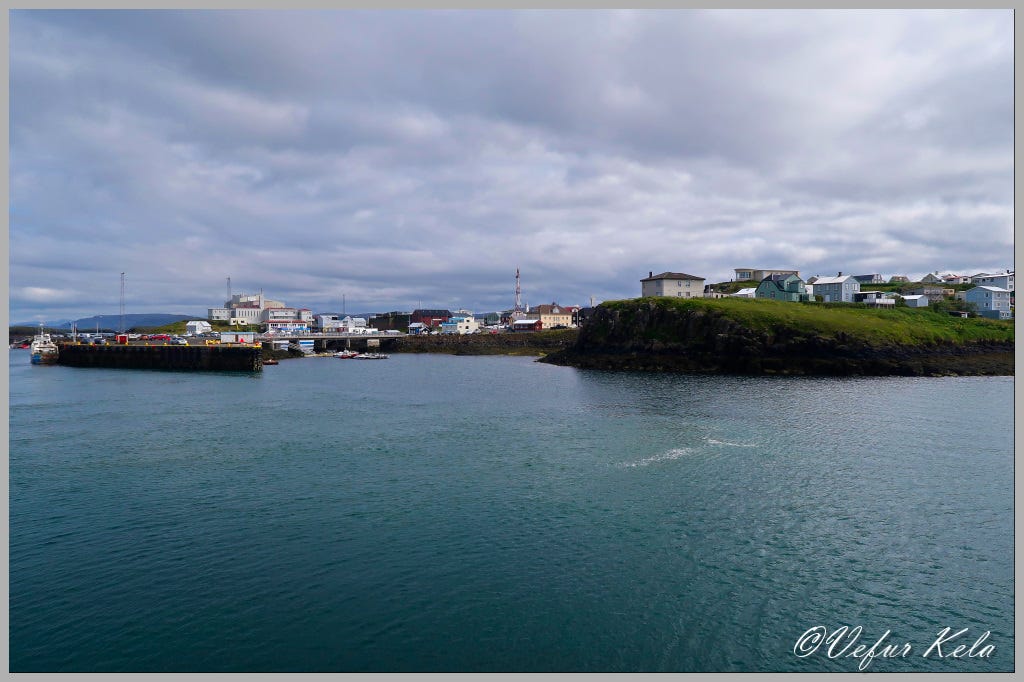
It turned out to be quite an effort because we had to carry our stuff up the hill from the dock to the house. The house we are staying in is called Ráðagarður and is a few hundred meters from the dock. The trailer, which we understood was supposed to be either at the house or at the dock, was nowhere to be found. Therefore, there was nothing to do but tackle the carrying ourselves.
Actually, there were men on the dock with tractors and trailers, but they weren't there to service us, but rather the people intending to stay at the hotel. One of the tractor drivers turned out to be a merciful Samaritan and allowed us to quickly toss our stuff onto his trailer and moved it the last stretch. The next hurdle was finding the key to the house. Then, when we opened the front door, the transport carts were staring us right in the face in the entryway. I should have looked in through the window there when I dashed up to the house in search of the carts.
Flatey is one of the 40 West Islands of Breiðafjörður, and it is the largest of them. The island is about two km long and half a km wide at its widest point. As its name suggests, it is flat. Its highest ridge is Lundaberg in the northeastern part. There, the cliff is 10–12 meters high. It has been inhabited in Flatey since the earliest times. The settler Þrándur mjóbeinn was the first to live on the island. Flatey is well situated for rich fishing grounds. The harbor is a horseshoe-shaped rock formation that provides shelter from all directions. When the first census was taken in 1703, 106 people lived in Flatey. The inhabitants were most numerous just after the turn of the century in 1900, when about 200 people lived on the island. After that, permanent habitation in Flatey began to decline, and today five people have permanent residence on the island all year round. In the summer, however, there is a lot of life in Flatey because the island is a popular summer vacation spot due to its pleasant weather. The village itself is at Gríluvogur, and it is a delightful collection of old houses from the 18th and 19th centuries.
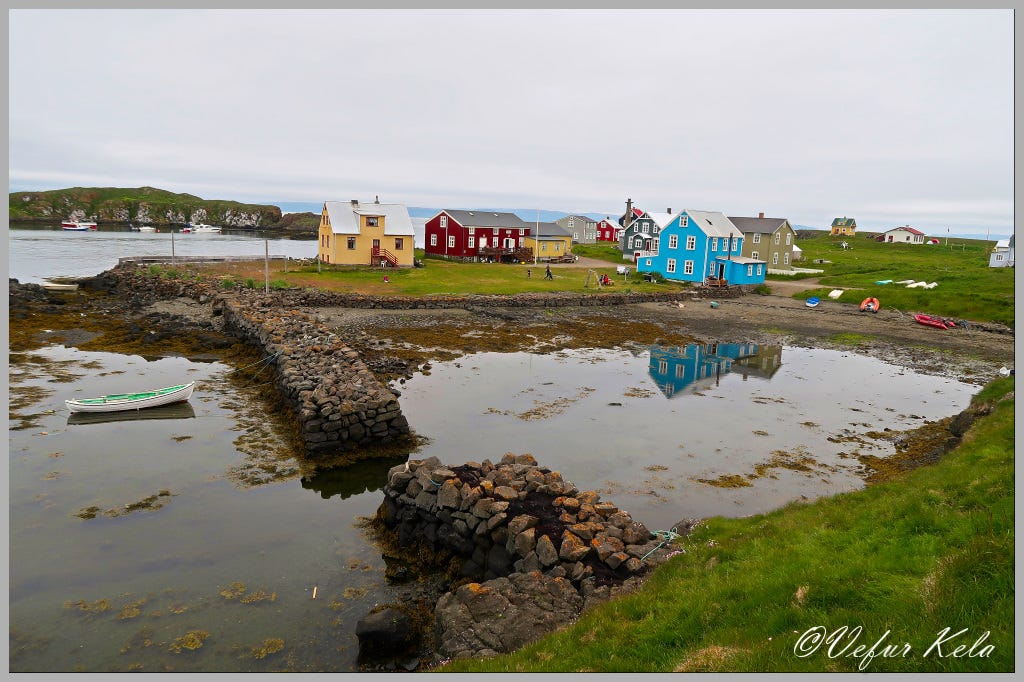
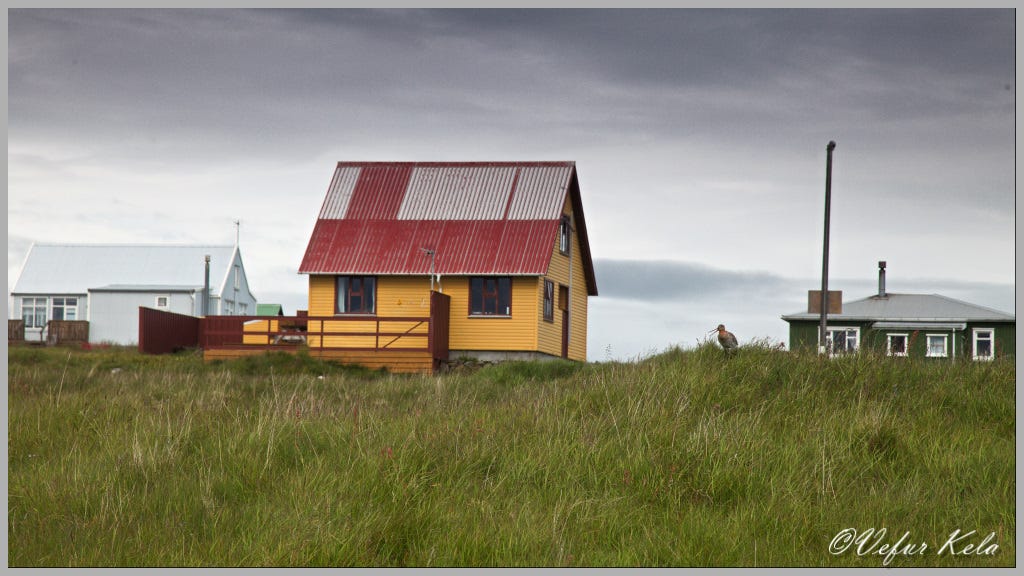
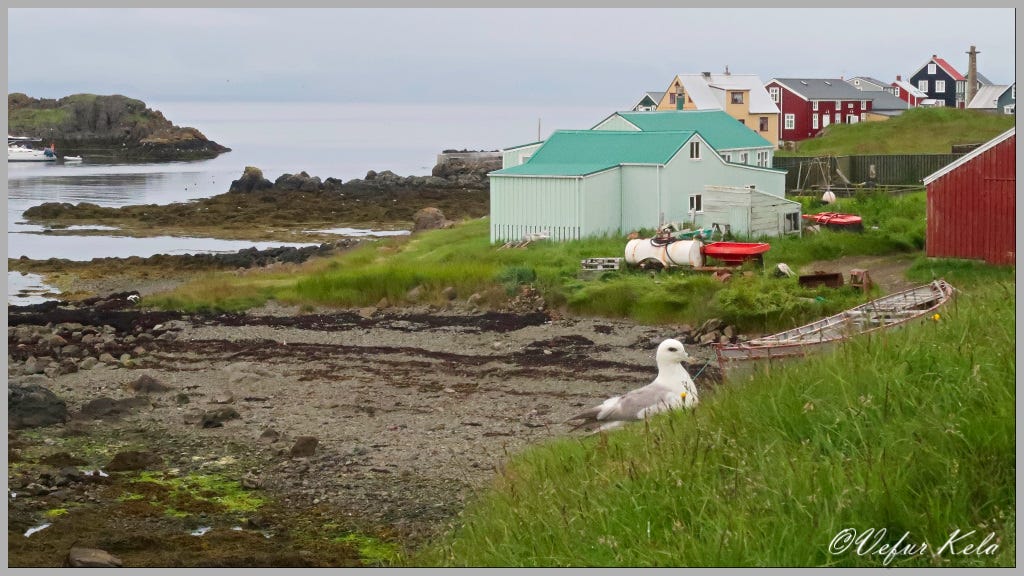
Saturday began exactly the way you want it to when you are on summer vacation. At a slow pace. We went out after noon and strolled down to the village. We looked at the old houses there. Most of the houses have been nicely renovated, and the entire environment is tidy. Actually, aside from the sheep manure that you might step in, even right outside the front door. The sheep, you see, roam freely all over the island. Our walk ended at Lundaberg, which bears its name because of the puffins that live by the cliff. We sat on a bench there and enjoyed watching the birdlife. We met the park ranger and had a long chat with him. He is from Patreksfjörður, and we could, of course, discuss that area as well. It hasn't been that many years since we traveled there, and I also lived in the neighboring village during my teenage years. The ranger told us that the puffin population by the cliff had suffered somewhat. Just off the cliff is a nesting sanctuary that is closed to public access until July 15th. The idea is to give the birds peace to nest and raise their young. They are specifically looking out for the Red-necked Phalarope, as a few pairs nest on the island. It wouldn't be bad to see a Red-necked Phalarope, as that bird is particularly uncommon here in the country. Otherwise, we saw various types of birds on this walk of ours. Chickens greeted us by the road down to the village, and by the house, a Black-tailed Godwit sat on a pole. At Lundaberg, there was a lot of Arctic Tern, and a Snow Bunting waddled around us while we sat there. We also saw an Oystercatcher, a Red-necked Phalarope, and a Fulmar.
Around four o'clock, we came back to Ráðagarður and matters were dissected with our fellow travelers. Jóhann clearly enjoys finding a weak spot in teachers, being surrounded by such people in his in-laws' family. From him, I learned this verse.
Eins varð ég áskynja í réttinni.
Ekki skal lúrt á fréttinni.
Hér hef ég séð
hvað sauðkindin er
keimlík kennarastéttinni.
I noticed this at the sheep round-up,
the news shouldn't be lingered over.
I have seen here,
how the sheep is
quite similar to teachers.
We heard that there would be a dance at Hótel Flatey that evening. Around half-past nine, we went there. We bought ourselves drinks, and around ten o'clock, the festivities began. The band Skárri en ekkert (SKE) [Better than nothing], led by Guðmundur Steingrímsson, began playing for dancing. The small hall was packed with people of all ages—from children up to older people. We suppose we have to admit that we were on the older side at this gathering. The dancing was thunderous and typical of modern Icelandic dancing. People jumped up and down. There wasn't really anything else possible in the cramped space.
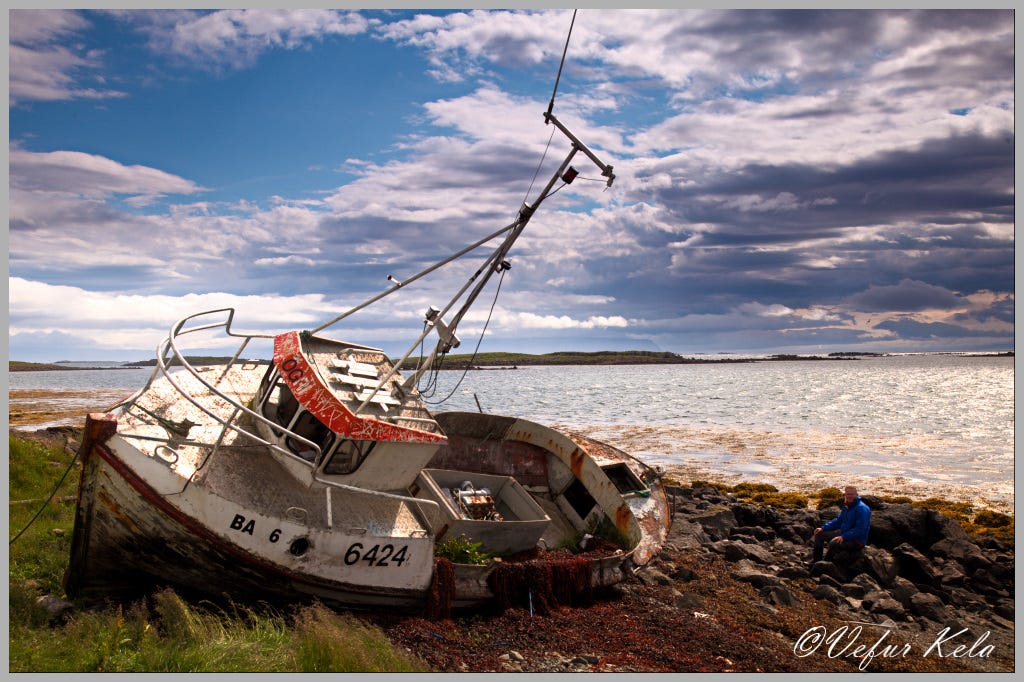
Sunday dawned. The weather was fine; it had rained during the night, so everything was soaking wet. We took our first photography walk along the southeastern shore from the dock to the church. On the way, I was, of course, scanning for a promising spot to cast a fishing line. I think I will start by trying the bay below Ráðagarður, where the wreck of the fishing boat lies on the shore. On the walk, we also looked into the library, which is notable for being the second oldest library in Iceland. It was built in 1864 and stood for ninety years where the church stands now. Then it was moved further inland onto the library green, and the church was built where the library used to stand. Originally, the library was built to house the book collection of the Flatey Islanders' Improvement Society and was built through the efforts of Brynjólfur Benediktsson.
Veðrið kom okkur skemmtilega á óvart á mánudeginum því hann reyndist bjartur og fagur. Snæfellsjökull blasti við okkur í suðri og fjöllin á Barðaströndinni í norðri. Til vesturs var opið hafið svo langt sem augað eygði. Við Guðrún höskuðum okkur út fyrir hádegi og skoðuðum kirkjuna og umhverfi hennar. Í Flatey hefur verið kirkja frá 11. eða 12. öld. Núverandi kirkja var teiknuð af Guðjóni Samúelssyni og byggð árið 1926.
In 1964, Baltasar Samper painted the altarpiece and ceiling paintings in the church. Due to poor conditions in the church, the original paintings were damaged by moisture, and Baltasar, along with his wife, repainted the work in 1992. The paintings they created trace the cultural and industrial history of the islands, and the models for the people are real islanders. Except for Jesus Christ, who stands in a wool sweater (lopapeysa) next to the last two farmers on the island. Jesus is suspiciously similar to Baltasar himself. Regardless, the work is magnificent.
Around half-past one, Guðrún and I headed down to the shore directly below Ráðagarður. We cast our lines out into Flateyjarsund or Svefneyjarsund. We used mackerel for bait. We let one line lie on the bottom and the other hang from a float. After about half an hour, the rod where the bait was on the bottom started to twitch, and a two-pound cod was landed. Fish took the bait four times, but only this one was brought to land. The others made a move but then disappeared. Conditions were a bit tricky because for the last few meters near the shore, the sea was covered in seaweed, and the fish had to be dragged over it. It was a good thing it wasn't any larger than it was.


Um kvöldið gengum við Guðrún út á Lundaberg og urðum þar fyrir alvarlegu aðkasti kríunnar. Þar sem við göngum eftir göngustígnum steypir hver krían eftir aðra sig yfir okkur og voru þær illskeyttar mjög. Ósvífni þeirra átti sé engin takmörk og náðu þær að drita á bæði mig og Guðrúnu. Ástæða þess hve illskeyttar þær voru átti sér skýringar. Á göngustígnum voru kríuungar sem fullorðnu fuglunum fannst nauðsynlegt að verja.
An unusually deep low-pressure system for this time of year is now approaching the country from the south and will cause heavy rain in West Iceland. The low will move slowly, the meteorologist said, and smiled. Guðrún and I didn’t see any reason to smile about this because it meant that the unpleasant weather would drag on until Friday and in all likelihood prevent our plans to fish in Hraunsfjörður in the latter part of that day. We will see what happens with that. Possibly, the low will have moved far enough east when we come ashore that a fly will be cast into Hraunsfjörður after all.
We decided to walk around the eastern part of the island on Wednesday morning. We enjoyed the outdoors and watched the behavior of the birds. It would have been very nice to have a decent zoom lens because the opportunities for bird photography were endless. However, we managed to take good pictures with our 100 mm lens because the black guillemot and especially the puffin allowed us to get quite close to them. Guðrún even thought she managed to capture a Red-necked Phalarope in a photo, but it was on her phone, so the picture is rather unclear. It seems to be becoming a rule that when Guðrún and I rent a summer house and Harpa takes care of the dog, she [Harpa] ends up in some kind of trouble. Last year, her basement flooded. Now, Lappi got sick. The illness manifested in vomiting and diarrhea.
The weather on Thursday did not offer much opportunity for outdoor activities, so the time was mostly spent reading and writing. Guðrún prepared a delicious meal for us from the cod we caught off Tröllendi. Afterward, we had waffles and whipped cream for afternoon coffee, so we were certainly not lacking anything. I did actually dash down to the shore and cast a spoon lure, but I didn't last long at that activity. I found it uncomfortably slippery on the wet rocks. In the afternoon, Guðrún and I were getting bored of the confinement and strolled down to Vesturvör to take pictures of the sea's movement with the village and the harbor in the background. I think we managed to take some good pictures.


