Originally written 31 March 2021.
The people of Grindavík are not easily rattled, accustomed as they are to the harsh forces of nature shaking and stirring them. By March, however, they had reached their breaking point and complained bitterly—and they certainly had every reason to. They had barely been able to keep their footing since the new year due to constant seismic activity that seemed to have no end in sight. Met Office (Meterological office) sensors recorded tens of thousands of earthquakes, several of which were powerful enough to be clearly felt here in the capital. Three of them measured over magnitude five. Daily, scientists appeared in the media, stating with a wise air that either the earthquake swarm would stop, or it would continue. Indeed, this is great science, and it is fairly certain that the scientists will not be proven wrong.
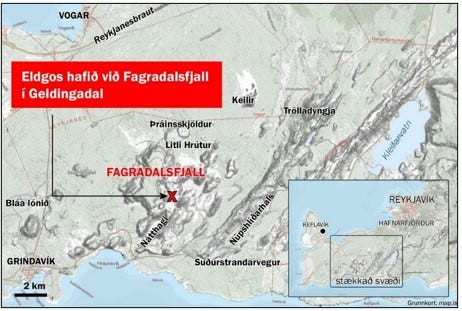
The people of Grindavík continued to be shaken, and now people began to wonder if the fires in the bowels of the earth were forcing their way to the surface. The wise scientists were questioned intensely: could this be the case? They replied, quite truthfully, that either an eruption would occur, or it would not. The uncertainty began to frustrate many residents so much that many had started staying elsewhere than in their village. To top it all off, the power went out. The people of Grindavík felt mistreated and demanded explanations. One scientist, however, was more specific than the others and stated that there was a very slim chance of an eruption. The next day, the eruption began in Geldingadalur.
Now the people of Grindavík breathed a sigh of relief, as the Met Office scientists said the eruption would release the tension and thus reduce the seismic activity. Being experienced, they also noted that there was still tension elsewhere on the Reykjanes Peninsula, and a sturdy shaking could very well occur further east. Or not. But the residents must have been relieved regardless, as the shaking certainly subsided. Furthermore, the eruption was in a convenient location—it was small and “cute,” so no harm was done. However, “Adam was not long in Paradise,” as the curious inhabitants of this country are now flocking to the eruption site, and the road for all of them leads through Grindavík. Residents can barely make it to the grocery store due to the gridlock of cars. At the time of writing, social scientists have yet to comment on this. But if they were asked, they would surely say with a wise air that two scenarios are possible: either the stream of people to the eruption site will stop, or it will continue. The people of Grindavík must continue to live with the uncertainty.
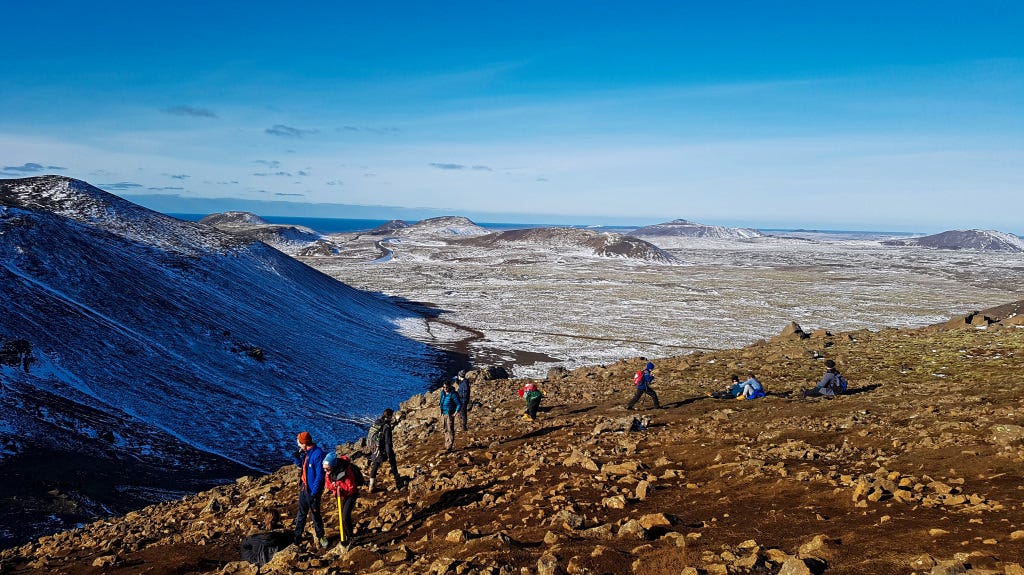
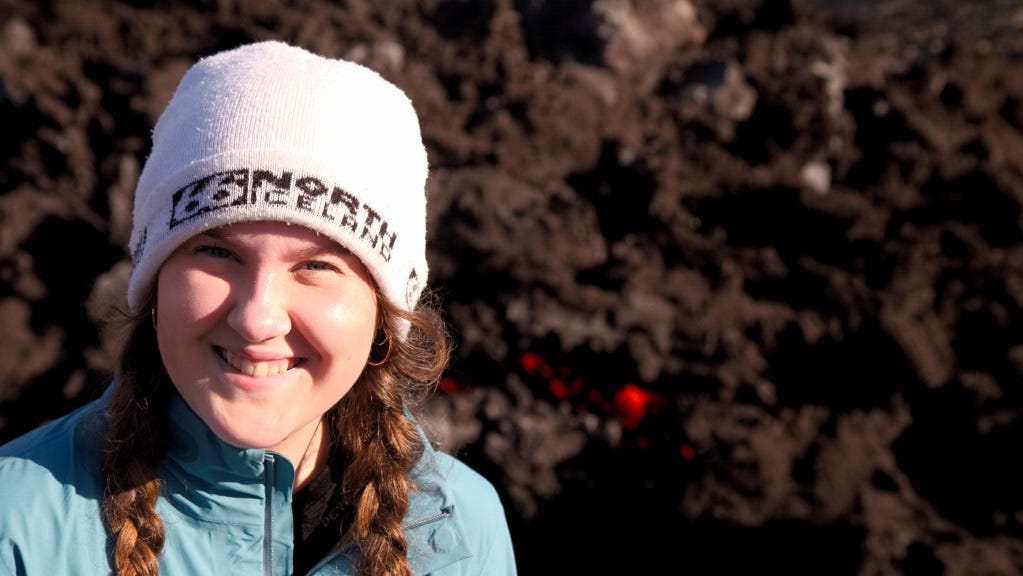
This was a long introduction to what was meant to be the core subject of this article. On the morning of March 31st, my daughter Lilja and I saw an opportunity and headed straight west to Geldingadalur. We were far from being alone; a crowd of people was there for the exact same reason. A friendly search and rescue member directed us to a parking spot, and we set off on foot. The rescue teams in Grindavík have been keeping watch at the eruption site day and night, and they are complaining bitterly. They aren’t complaining about their own lot in life—not at all. They are worried about the lack of preparation among hikers, as many stroll out into the wilderness completely ill-equipped for trekking in these conditions. Lilja and I were, of course, model hikers—well-prepared with both snacks and sturdy new boots. When we looked around, we saw that the rescue workers’ concerns were entirely justified. Some hikers were just clueless. Most people, however, were in good shape.
The hike took us an hour and twenty minutes. By then, we had arrived at Geldingadalur, which can hardly be called a valley anymore, as the lava is well on its way to filling it up. Geldingahraun will likely be the place name used to identify the area in the future. We walked alongside the lava flow until we saw the fountains of magma spewing from the two craters. We sat down there and had some cocoa and snacks. We photographed the spectacle incessantly, simply enjoying the show that Icelandic nature is putting on these days.
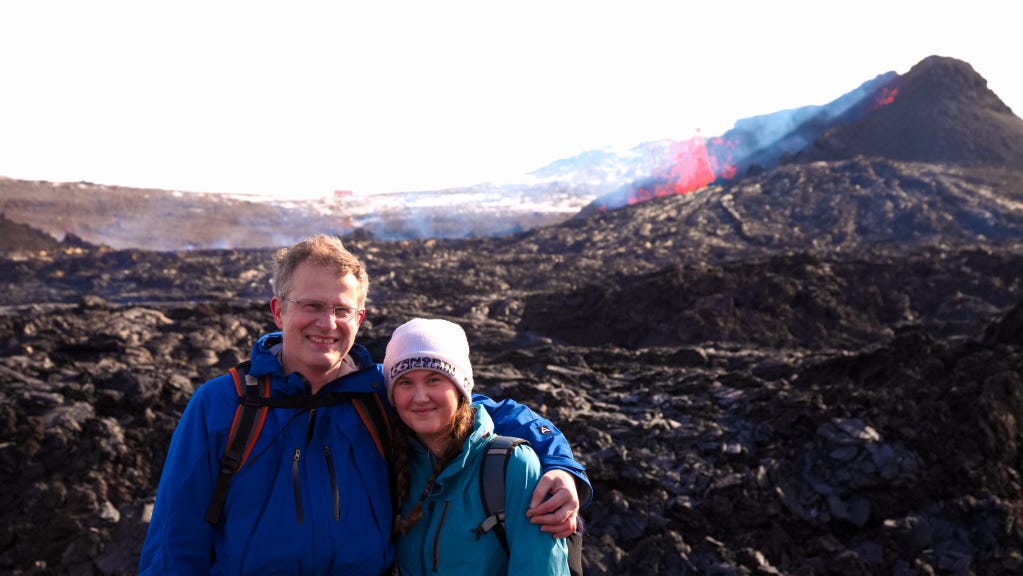
As we sat there on the hillside overlooking the craters, we wondered how long this eruption would last. This is a question our scientists have answered with their customary precision: possibly the eruption will end tomorrow, or it will continue for many years. At this point, a kind reader might begin to wonder if the author’s intent is to disparage our excellent scientists—that he is sailing under false colors, pretending to recount a hiking adventure only to launch into aimless rants. No, that is not the case at all. Thanks to Icelandic scientists, my daughter and I were able to discuss the natural wonders before us with considerable wisdom and insight. Our scientists are simply cautious, refusing to let the media bait them into making assertions for which they have little evidence.
Naturally, we took advantage of being out on the peninsula and drove past Kleifarvatn on our way back. I intend to look into fishing possibilities at Kleifarvatn this spring. Even though the lake is a short distance from the capital, I have, strangely enough, never tried my luck there. That will be rectified this autumn.