
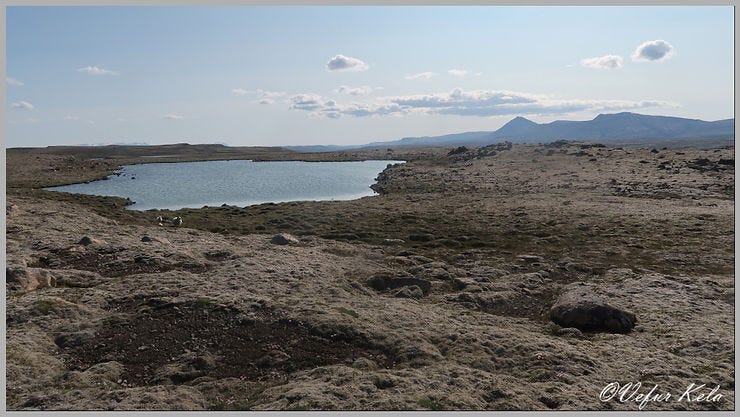
High up in Hellistungur, there is a small lake called Gíslavatn. According to my late father-in-law, this lake holds excellent Arctic char. He proved this himself while fishing up on the moor, though those fishing tales are now 60 to 70 years old. Back then, every 'food hole' was sought out and utilized. Today, I doubt a single person visits this lake; it is far from any beaten path. The fishing rights are held by the owners of Gilsbakki, as the rights to many lakes on Tvídægra belong to that farm. The clerics of Gilsbakki in centuries past were clearly industrious in securing fishing rights here and there. Regardless, it’s highly unlikely one would ever encounter a rights holder at Gíslavatn defending their claim.
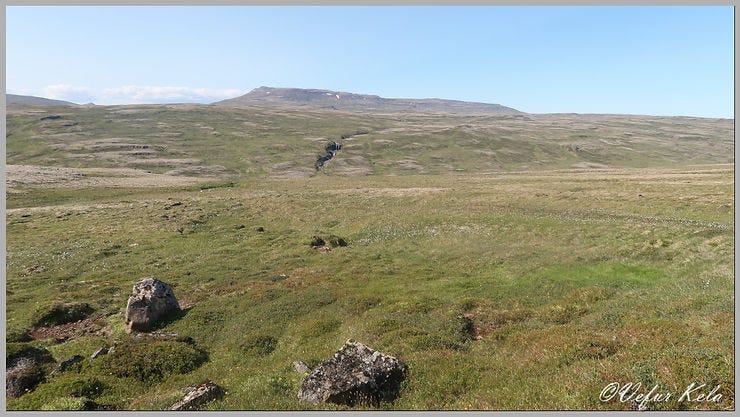
Gísli, for whom the lake is named, was the son of the settler Þorbjörn ‘blesi.’ Þorbjörn reportedly lived at Blesastaðir; legend says the ruins of the farmstead are still visible south of the Hellisá river, well above the farm Krókur. His son Gísli also lived up there, though not at Blesastaðir. I find it hard to believe anyone could have sustained a living there unless the climate before the year 1000 was entirely different from today. However, I didn’t intend to discuss those figures in this article—I’ll save that for when I track down Blesastaðir.
I decided to investigate the fishing myself and took a hike up to the lake with waders and a rod in my backpack. Dressed in light hiking gear, as the temperature was 20°C under a blazing sun, I set off. I have actually hiked to the lake and tried fishing it before. Back then, I was young and fit. Now, I am middle-aged and fit, so little has changed. I started my trek across from the bridge over Búrfellsá. This time, wading across the Norðurá river was trivial, as the summer droughts have reduced it to little more than a stream. The plan was to call my wife upon my return so she could pick me up at the same spot. Since there was no signal at Brúará, we agreed to hope for a connection once I gained some elevation. As a backup, we decided she would pick me up at midnight if we couldn’t get through to each other.
The hike up the ridge wasn’t particularly grueling, but it certainly worked up a sweat—hardly surprising, as merely thinking about moving in such heat is enough to make one perspire. Once at the top, the trek across the moor and the search for the lake began. According to the maps, the lake should have been similar in size to another nearby lake we know, with several ponds to pass along the way. I made a point of climbing the highest vantage points to get my bearings. When I finally believed I had found Gíslavatn, I was still skeptical because it was much smaller than our map indicated. I continued south until the land began to slope down toward Hellisá, then doubled back to a cairn standing on a hill above the water. I called my wife; there was a signal there.
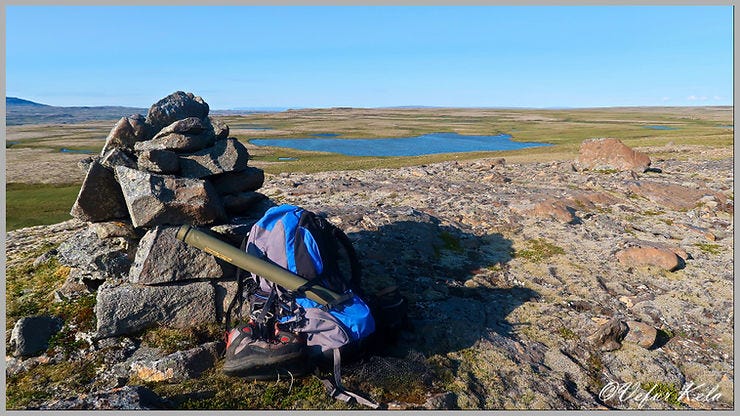
By that point, I had been hiking for three hours with very few stops, though I did take the time to capture some photos. The water below the cairn was undoubtedly Gíslavatn, so there was nothing left to do but head down to the bank and cast a fly. A northerly breeze was blowing, but it wasn't so strong as to make casting difficult. The lake itself was murky; it takes very little wind to stir up a body of water like this, as it is incredibly shallow—a typical moorland lake with a silty bottom. I found myself wondering if fish could even survive here, as it's so shallow it must nearly freeze to the bottom during harsh winters. Presumably, there is a deeper section out in the middle. On the lake, a pair of swans swam with three cygnets, and some species of duck with a single duckling settled briefly in the center. An Arctic Tern was hunting over the water, and another pair of swans glided just over my head as I stood out in the water, casting.
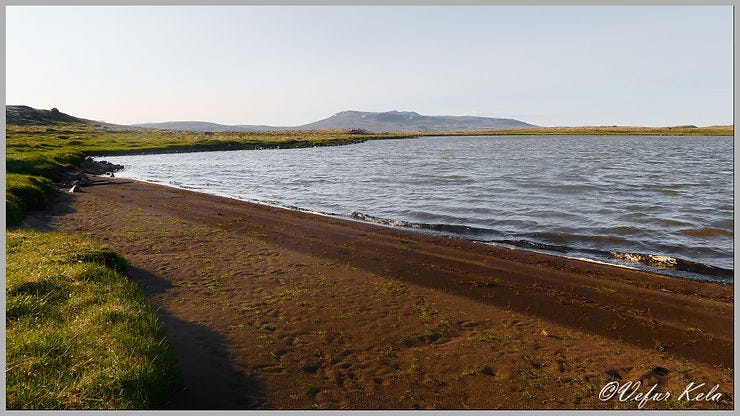
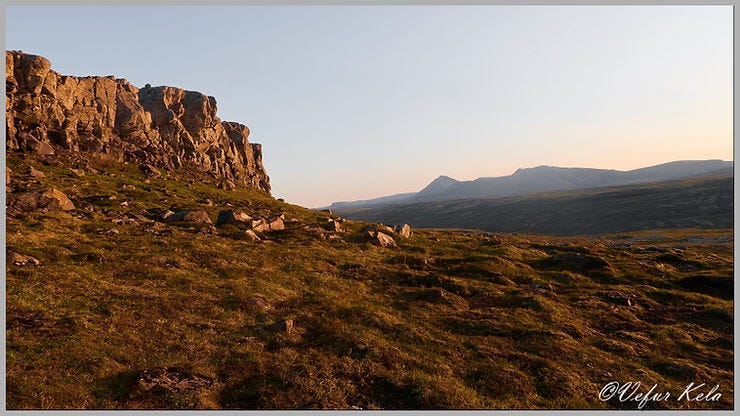
I spent about two and a half hours casting my fly but saw no sign of life. Around ten o’clock, I began the hike back, which took only an hour and fifteen minutes, as I walked with more purpose and never had to climb uphill. By the time I could see down to the highway, the sun was setting. I must have taken a slightly different bearing than on the way up, as I reached the Norðurá river much further west than where I had started. It didn’t matter, though; the river was just as easy to wade there as it had been further up.
My conclusion regarding fishing in Gíslavatn is that it isn’t worth the effort. However, it is well worth the hike just to enjoy the outdoors and the scenery. In that case, I would recommend continuing across to the Hellisá river and following it down to where it joins the Norðurá, just below Klapparhylur. I did that the first time I hiked to Gíslavatn, though that route is significantly longer.