
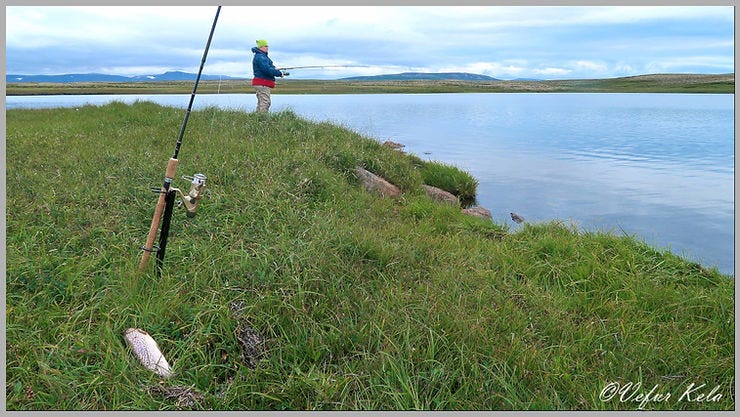
I managed to convince Guðrún that it might be fun to trek over to Gullhamarsvatn instead of just settling for Hólmavatn. Lately, long hikes haven’t exactly been her favorite thing. It’s not a particularly long walk, but since we had never fished in Gullhamarsvatn before, we weren’t entirely sure how demanding the terrain would be.
Around 2:30 PM, we packed our lunch, tossed the gear into the car, and drove across two plateaus and up a third to reach the lakes. The trail up to Hólmsheiði from Sólheimar isn’t for just any vehicle, but our new car proved it’s perfect for this kind of off-roading. The trail is 3.5 kilometers long and can only be driven at a walking pace. About 1.5 kilometers in, the track forks; we took the one leading east of Hólmsvatn and hiked from there over to Gullhamarsvatn.
The path took us between Hólmavatn and Reiðgötuvatn, with Hólmavatn to our south and Reiðgötuvatn to the north. After that, it was a pleasant stroll across marshes and moorland until we reached Gullhamarsvatn. While we ate dinner by the lake, we wondered if we were in the right spot. According to the description, the lake is situated beneath a cliff called Gullhamar (Gold Cliff). No matter how hard we looked, we couldn’t see a cliff, though in the distance to the northeast, we spotted a rock formation that might have been the one with the expensive name. Still, it seemed so far away that saying it stood ‘by the lake’ felt a bit inaccurate.
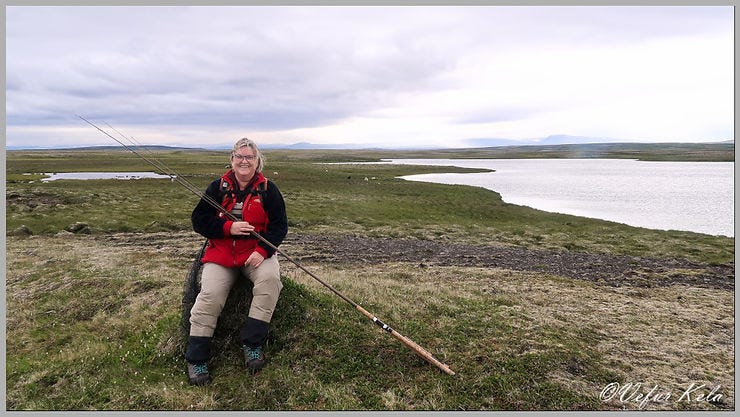
The trout preferred the fly, followed by the bait, but we had no luck with the spinner. My wife and I have fished Hólmavatn three times before, and every single time it has been miserably windy. This time was a completely different story, as it was calm for most of the time we were fishing. Reviews of the Sólheimar lakes say they are best fished in overcast and gloomy conditions, but that didn’t quite match our experience this time—it was cloudy but warm.
The fishing started slowly, though my wife soon landed a one-pound brown trout. We moved slightly to the west and quickly spotted a fish rising. We cast out a dead drift (the ‘lazy’ rig) just to the side of the rise, intending to target the main area with our flies. Almost immediately, a two-pound trout struck the bait. We switched to a dry fly, and soon the trout started taking that as well. When things slowed down, we changed to an orange Nobbler, which got a strike on the very first cast. Finally, we tried a Teal and Black fly pattern, and the trout took that one too.
As it began to get dark, we hiked back to Hólmavatn. Naturally, we made a few casts from the spot where Guðrún landed several fish last year. There, a one-pounder took the bait. In the end, the fly was most effective, followed by the bait, while the spinner yielded nothing.