Lake Heiðarvatnið 19. august 2017
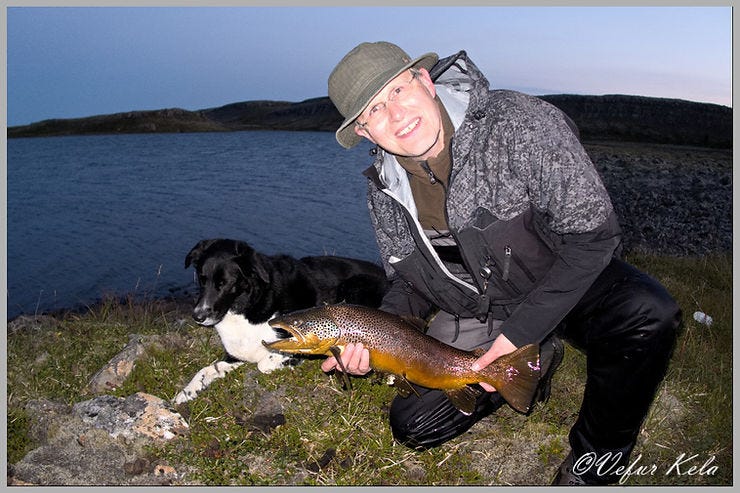
Red wine optimism, a tedious dog, and an orange trout.

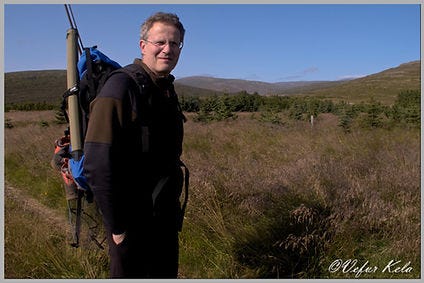
The man and the woman, a middle-aged couple not exactly in peak hiking shape, mustered the resolve for the trek with solemn vows to discipline themselves: they would walk slowly and with dignity, stopping often to ensure they wouldn't arrive at the water’s edge drenched in sweat. Only one of those things held true. The couple did indeed walk slowly and with dignity, yet by the time they reached Rjúkandaborgir, the sweat had broken through. The sky was clear and the sun provided warmth, though the northerly breeze kept the temperature at a crisp ten degrees. At Guðrúnarvarða, just a few steps south of Rjúkandaborgir, the couple sat down to inspect the state of the bilberries. It was just as they had suspected. The lack of sun earlier in the summer had stunted the berries' growth, leaving them tragically few and far between.
The couple sat down on the lakeshore at a familiar spot; they were no strangers to this place. To the south, a pair of swans swam with two cygnets, while nearby on the northern shore, a solitary Great Northern Diver fished alone. There was no sign of a mate or chicks. A tragedy must have unfolded here. After a short while of fishing, the landowner called, having just finished some fencing work. He shared the news that his son-in-law had recently landed a five-pound trout in the lake. ‘Well now,’ the man thought to himself. His own personal best in this water had never exceeded four and a half pounds.
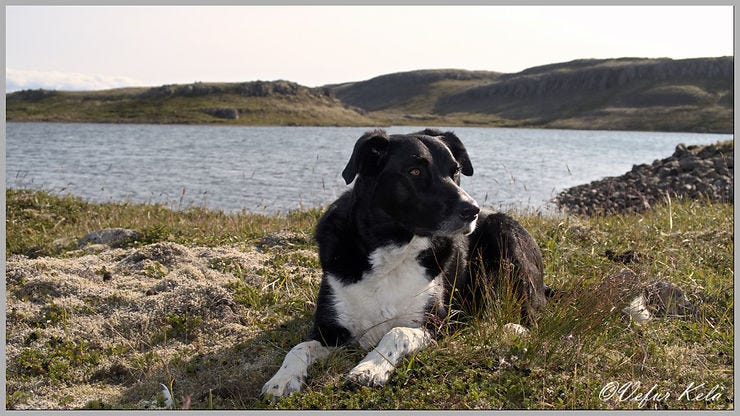
The couple began fishing at their favorite spot, but there was nothing to be had. They then walked south along the western bank, past Réttartangi point. There, they sat down, brought out the thermos of cocoa, and deliberated. It was decided that the man would fish the western bank south of the point, while the woman would fish the southern shore of Réttartangi itself. The dog stayed with the woman and was, for the most part, a nuisance. He is a poor fishing companion. They hooked one trout but lost it. The man managed to land one brown trout of nearly two pounds on the western bank. Afterward, they fished the entire length of the western bank on the way back, but with no further success.
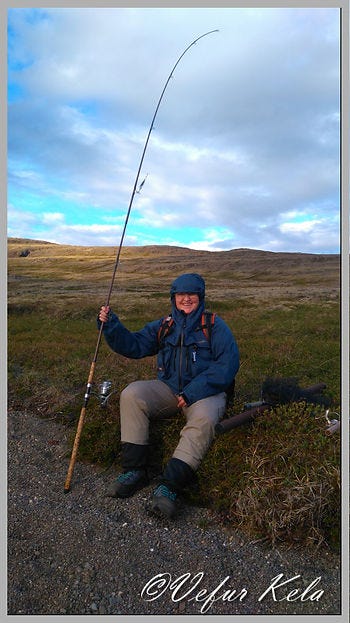
The hour was growing late, and the couple intended to end the trip on the same bank where it had begun. After trying the fly for a while, the man fetched his old Hercon casting rod and flung a spinner far out into the lake. During the retrieve, he felt a tug at the lure, and then another just as the retrieve was nearly finished. The man struck, lifting the rod in hopes of hooking the fish. As the spinner rose to the surface, he saw a large, orange-hued trout bolt out of the water; with thrashing tail-kicks, the fish skipped like a stone across the surface after the lure until gravity finally pulled it back under. It never caught the spinner, as it had already reached the tip of the rod. ‘What a sight, what ferocity,’ the man thought.
He continued casting, but nothing happened. He switched back to a fly, thinking how magnificent it would be to catch such a fish that way, but all remained quiet. By now, it was very late, and time to head home for some sleep. As a final effort, the man decided to offer a black Rapala minnow, and suddenly, the rod was nearly ripped from his hands. The force was such that the heavy-duty Hercon rod bent double and the line screamed out. The man reckoned this had to be an 8 to 10-pound fish. He began to worry that the blood knot wouldn’t hold or the leader might snap. After the man and the fish had wrestled for a while, the trout began to give in. Slowly and steadily, it moved closer until it was clearly visible. It was a brown trout, though not quite as large as the struggle had suggested. The lure had hooked him in the side. Once landed, it proved to be a beautiful male weighing exactly 2.71 kg—just under 5.5 pounds.