
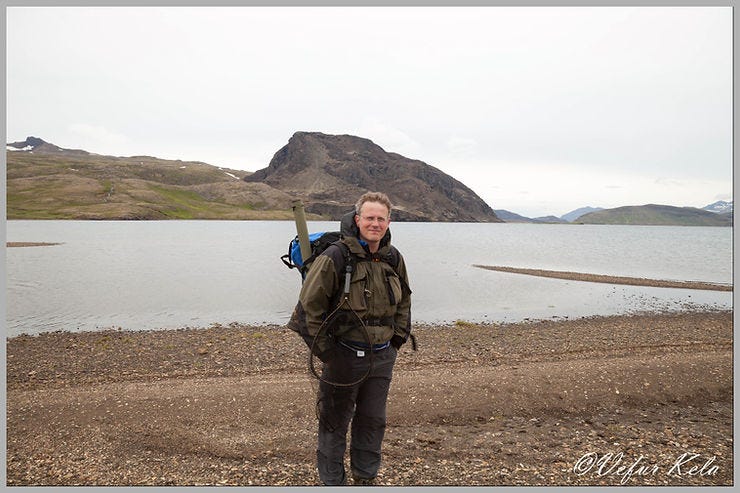
It had been several years since I last fished in Hítarvatn, so it was time to renew the acquaintance. Therefore, it was an easy decision when my companion suggested we head west to fish the lake for a day.
Our plan for the day was to hike along Vatnshlíð to the northern end of the lake and fish there throughout the day. As evening approached, we intended to fish selected spots under Vatnshlíð on the way back. The hike is about eleven kilometers long and takes two hours. It is a relatively easy walk with little climbing. When we arrived at the dam, aelderly n man and another middle-aged man were starting their trek along the slope. They clearly had the same idea as us. The older gentleman was well on in years, and I admire that a man of his age has the physical strength for such an undertaking. I truly hope I am fortunate enough to be able to do the same twenty years from now.
Given the age difference, we quickly caught up to them—anything else would have been to our shame. We chatted for a bit, and the old man said: ‘Since you are familiar with these parts, you should be able to answer this. Here at the front is Foxufell, and above it is Grafheiði, but what is the name of that mountain there?’ he asked, pointing his staff at a range north of Grafheiði. Since I have studied the place names around the lake a bit, I should have been able to answer, but to my embarrassment, I simply could not remember the name. After looking into it once I got home, I believe I am correct in saying that next to the lake, north of Foxufell, are Lambahnúkar, but the more distant mountains the old man pointed to are called Smjörhnúkar. The valley east of Lambahnúkar is named Burstadalur. The old man mentioned he had read an old poem about this area where Foxufell was called Kakalafjall. He explained the name kakali, saying it was meant to mimic the ‘gaggle’ or barking of a fox.
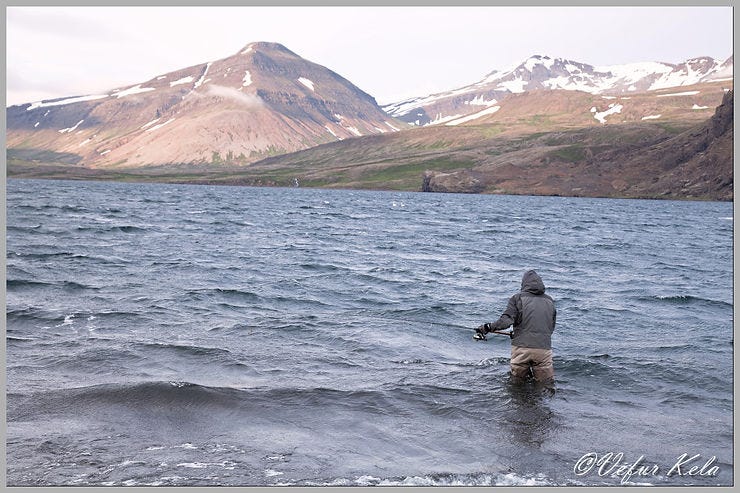
When we arrived at the head of the lake, we weren’t too pleased with the sight, as there was a multitude of tents. It almost looked like a family reunion was in full swing. Fortunately, these were hikers who had decided to rest their weary bones at Tjaldbrekka before the next leg of their journey. We began fishing off the mouth of the Burstaá, but there was little life to be found, or so we thought.
A bit later, the old man and his companion arrived, and it was quite a sight. The old man started pulling the char out, one after another. He was generous with his advice when he saw we weren’t catching anything. The fly he was using was a Teal and Black, fished on a slow-sinking line. I was using a floating line and various other flies. In my fly box, there wasn’t a single Teal and Black, but luckily my companion happened to have a few tucked away.
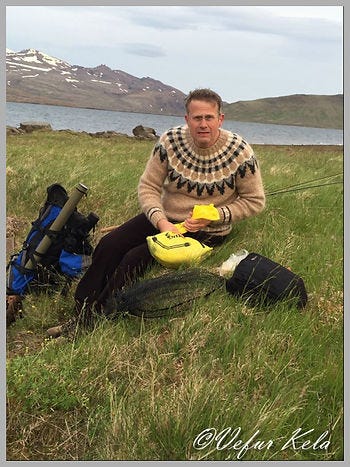
Due to our lack of luck, there was obviously nothing to do but try a new approach, so I rigged up a slow-sinking line and the aforementioned fly—and lo and behold! I got a take immediately. I then landed four brown trout in a row, and shortly after, a fifth. Inside the stomachs of the trout was a larva that looked exactly like a Teal and Black without wings. Why I caught only trout while the old man caught only char, I cannot explain, other than perhaps he was over a school of char and I was not. There could, of course, be various reasons for the poorer catch compared to previous trips here. One explanation could be the unfavorable wind, as this time it was from the north, whereas in previous trips, it had been southerly.
Because of the fish’s reluctance to take, our burdens were no heavier than they had been in the morning. That night, as I was preparing for bed at Brautarlækur after this fine day, I saw that I was now one toenail poorer on my left foot, and in all likelihood, I will also lose one from the right. There was the explanation for the soreness I had begun to feel on the hike back. Those cursed wading boots! I can, however, console myself with the fact that the family is two meals richer.