
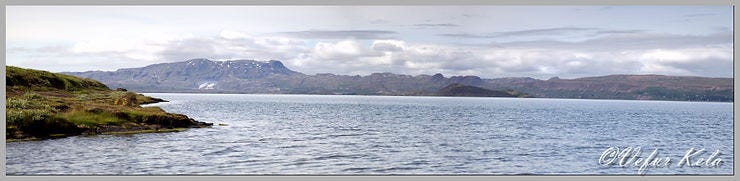
The weather forecast predicted mild weather, and the light wind that was expected was supposed to blow from the southeast. During my last trip to Lake Þingvallavatn, a friend of mine shared the wisdom that a westerly wind is by far the worst for fishing in the lake. He supposedly got this tip from experienced anglers, so I considered the information highly reliable. A northerly wind, on the other hand, was said to be much better.
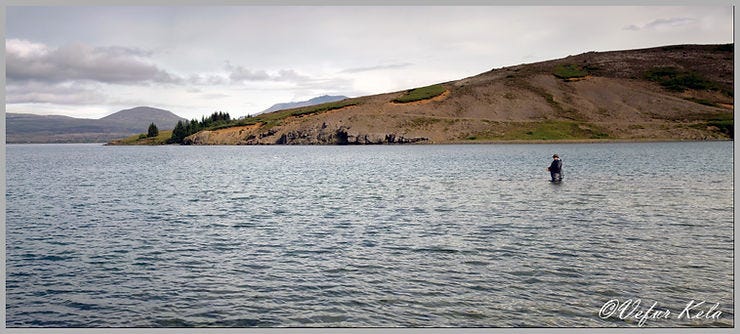
According to the forecast, fishing conditions were expected to be favorable on Tuesday, July 12th—a very mild southeasterly breeze. So, my wife and I got up as early as is considered “Christian” (civilized) and were ready on the shore south of Arnarfell by around 8:30 AM. However, nothing happened all morning, except for the sun beating down on us mercilessly while the Arctic Terns and Loons showed off their fishing skills. Around eleven o’clock, a fisherman arrived and marched straight along the shore toward Mjóanes. He then waded into the water and didn’t budge for the next three hours. To me, his entire demeanor suggested that this was a man who knew exactly what he was doing.
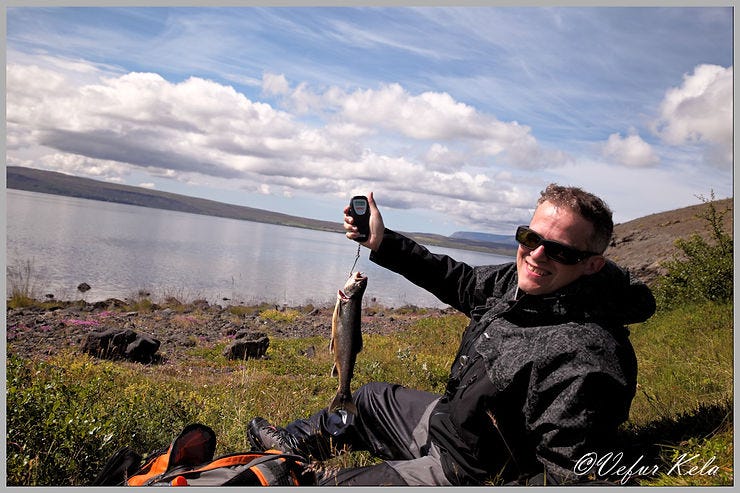
My wife and I spent most of our time on the gravel shore below Arnarfell, simply enjoying being outdoors in the beautiful summer weather. We hadn't had any luck with the fishing until I picked up the spinning rod. We were testing a new line that is supposedly designed to prevent twisting, no matter how often you cast. The line is braided, giving it a texture similar to fabric. You then knot the leader to the end of the line. I cast the lure a few times, and the line certainly performed as advertised. On one of the casts, a char took the bait. It turned out to be a 1.5-pound Arctic char (sílableikja).
Around mid-afternoon, we headed for home. By the car, we ran into the aforementioned fisherman, and my hunch turned out to be correct—this was certainly not his first time fishing there. He mentioned that he usually goes to this exact spot and never returns empty-handed. In his bag lay three Arctic char that had taken a small black fly. Since the man knew the lake so well, I asked him what he considered the worst wind direction for fishing there. He said he had heard it was the northerly wind. I couldn’t help but laugh and told him I’d heard that the westerly wind was bad, while the north wind was supposedly quite good. He laughed then and said, “That’s how the stories go.”
He had also heard that red flies were completely useless in the lake, yet his favorite fly—the one that had given him the best results—featured red. It was a small bead-head nymph; the body was braided black, except for the tail end, which was red. As for the wind direction, I think it’s most logical to conclude that success primarily depends on where you are positioned at the lake. The fish don’t disappear just because the wind shifts; they likely just move to a different spot.