
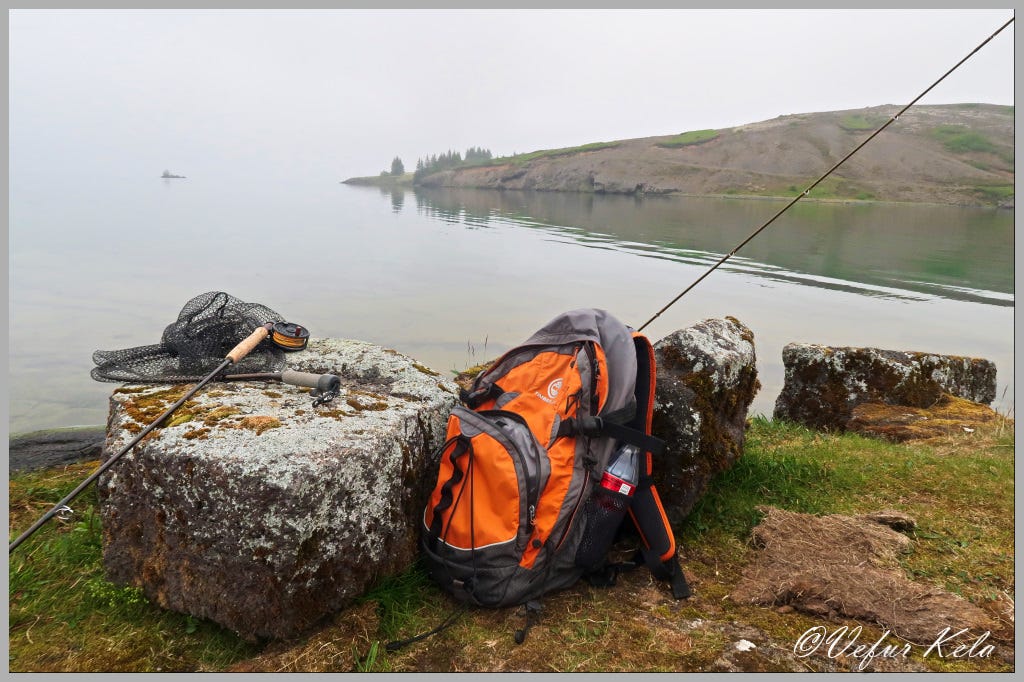
Friday and Saturday had been sunny and hot—the kind of days that represent the very best of the Icelandic summer. On Sunday, I made an early start. I pulled myself out of bed at 5:30 AM and headed to Lake Þingvallavatn. A thick fog lay over Mosfellsheiði moor. It was slightly clearer by the lake, though visibility was still low, but it was calm and warm.
I began fishing around seven o’clock by the rock on the eastern bank, out from the crack below Arnarfell. There is often fish there, and it’s a comfortable spot for casting. I didn’t get a bite, but there was definitely fish around, as I twice saw and heard splashes on the surface. At one point, a beautiful snail-type Arctic char (kuðungableikja) swam right past me. After fishing there for two and a half hours, I moved to the next promising spot.
To find the next likely spot, you have to walk a bit along the eastern bank toward Miðfell until you reach the next rock. I consider this place promising because a rock ridge along the shore and another one out in the water form a channel or a “crib” that the trout often enter. This channel starts at a rock above the bank and is about 120 paces long. At the beginning, it’s 15–20 meters wide, narrowing to 3–4 meters at the end. Wading there is a bit tricky because the bottom is so rocky. The ideal way is to wade along the outer ridge and cast into the channel. One can also try casting outside the outer ridge, as the trout might just as well be foraging in the rocks there as inside the channel.
Because it was so calm, I could clearly see the contours of the bottom and whether there were any fish in the channel. Every now and then, char would swim toward the bank and poke around in the rocks. Despite my best efforts, I didn’t get a single take. As it was approaching noon, I decided to head home, though I planned to take a few final casts at the spot where I had started.
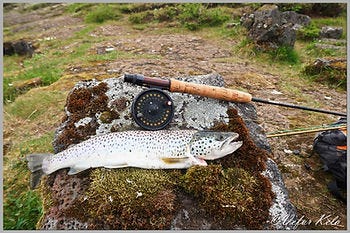
I cast a Black Zulu fly toward the bank below Arnarfell, and a trout took it. I saw immediately that it wasn't a snail-type char because the fish started by splashing on the surface. It was completely silver, just like a fresh sea-run brown trout. Once I landed the fish, it turned out to be a one-and-a-half-pound brown trout. It could have been bigger, though. Shortly after, I had another take on the Black Zulu, but this time I was casting toward Sandey. That fish got away, and I headed home.