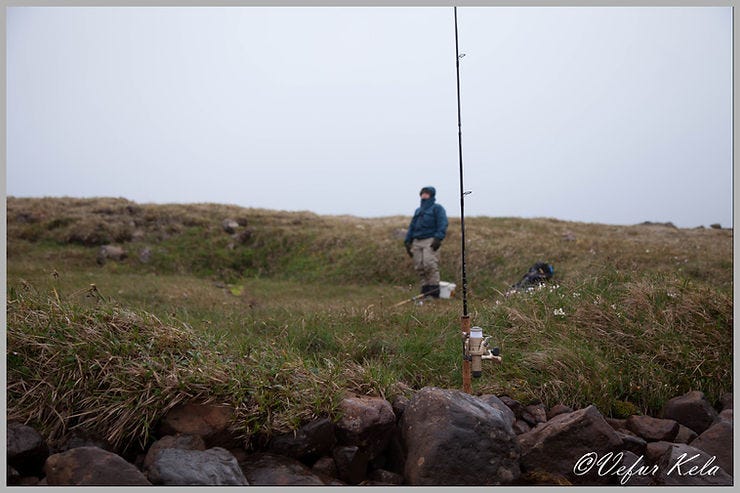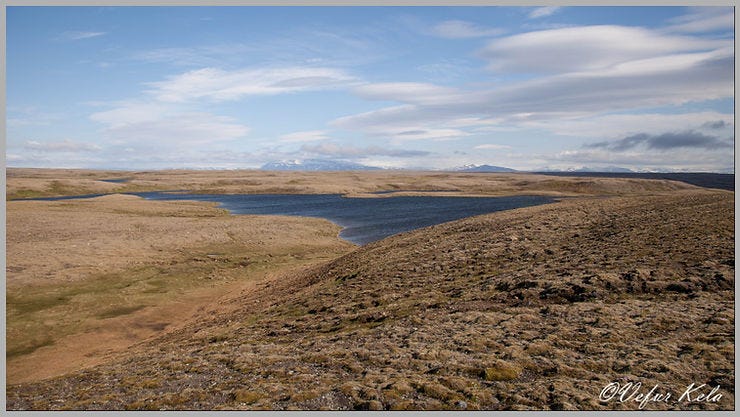
Despite the north wind showing no signs of letting up, the family headed back up to the moor for more fishing on Friday. This time, Tangavatn on Holtavörðuheiði was the choice. We know that lake slightly, as we have tried fishing there five times before.
Based on experience, we weren’t particularly optimistic about catching anything, as we know there isn’t a high density of fish in the lake. However, in three out of those five trips, we’ve seen signs of fish, and twice we’ve managed a meal. The conditions this Friday on Holtavörðuheiði were exactly the same as on Laxárdalsheiði the day before: a brisk north wind, eight degrees [Celsius] upon arrival, and six degrees when we headed home.
Tangavatn and Hólmavatn are not unlike each other in appearance—typical moorland lakes. Both have bays and points, though Tangavatn is somewhat deeper. It didn’t get as murky in the wind as Hólmavatn did. Tangavatn only holds Arctic char, while Hólmavatn has both char and brown trout, though I suspect there’s much more trout than char in Hólmavatn.
It went much as we expected; we returned home fishless that evening, but the trip wasn’t entirely without incident. Lilja cast a worm with a float from the bank against the wind. The cast was a complete failure, reaching only four meters out into the water. As she reeled in to try again, a large char struck the line right by the shore. Astonished, the girl tried to land the char like any other small fish—that is, trying to sweep it onto land in one go. Unfortunately, the drag on the reel was set to its tightest, making the tension on the line far too much. Such tactics aren’t enough for a fish of this size, and the char tore itself free. Lilja subsequently received a lesson on how to land larger fish, and we simply say: ‘Better luck next time.’