
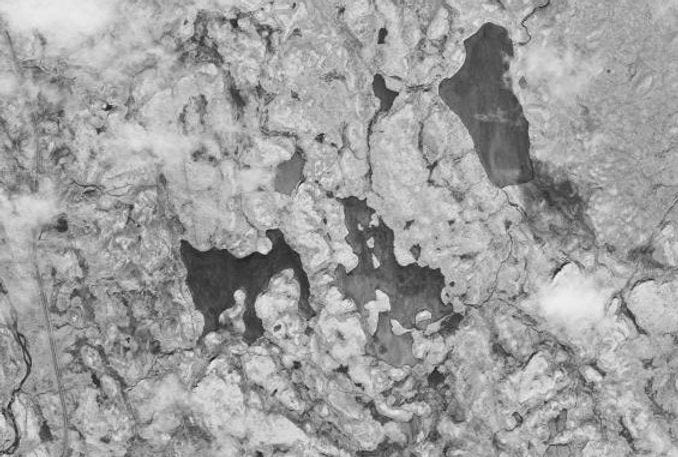
Last winter, I made it my goal to find time this summer to hike to Lake Djúpavatn and fish the three lakes: Djúpavatn, Tangavatn, and Krókavatn. These lakes are located on the border of Borgarbyggð and Húnaþing vestra. While Krókavatn and Tangavatn belong to Borgarbyggð, Djúpavatn is part of Húnaþing vestra. To be honest, I’m not entirely sure I have the names of the lakes right. My father-in-law called the first lake you encounter when walking east from the old quarries on Holtavörðuheiði ‘Krókavatn,’ and I think I’ll stick with that name from now on. The next lake is marked as ‘Tangavatn’ on maps, but I’ve heard two other names for it: Hólmavatn and Reipavatn. It would be interesting to hear from locals to get the nomenclature straight. Unfortunately, I no longer have access to my father-in-law’s knowledge, as he surely could have enlightened me further.
Tangavatn lies east of Krókavatn, and Djúpavatn is northeast of Tangavatn. The distance between them is short, and it’s a relatively easy hike—not much of a climb, just low hills and ridges. I walked northeast from where I left the car, as I figured that would lead me straight to Djúpavatn. That turned out to be correct; after about a thirty-minute walk, I reached the lake. The weather was calm and pleasant, but just as I was about to start fishing in Djúpavatn, it began to rain in the still air—and I mean a total downpour. My wading jacket was no match for the deluge, so I was soaked right at the start of the trip. It didn’t matter much, though, as it was warm. The lake looked very promising for fishing. I had the company of a Great Northern Diver (Himbrimi); that bird is always a sign that there’s fish in the water. There was also a pair of whooper swans. I didn’t have much luck with the fishing in Djúpavatn, though, except for one finger-long trout that grabbed my fly.
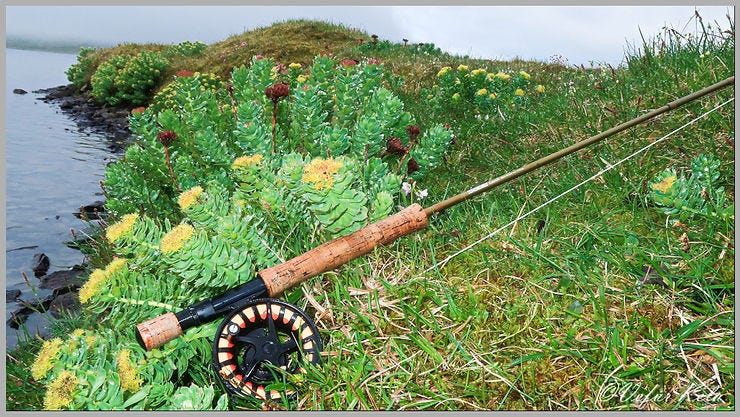
“It must have been nearing six o’clock when I decided to call it a day at Djúpavatn and headed back toward Tangavatn. I didn’t give that lake much time, as I intended to scout it quickly and finish my fishing at Krókavatn. I first reached the northern shore of Tangavatn, where I noticed a lot of foam along the water’s edge. I’ve heard that such foam can be a sign of fish, though that’s not always the case; it’s usually just organic matter whipped up by the wind and waves. I cast a few times there, as it looked promising, then walked along the western shore, casting here and there. About halfway along, I noticed how short the distance was to Krókavatn, with my car clearly visible on the ridge where I’d left it. It was reassuring to see how close the lakes were, making navigation easy even if visibility were to fade. Tangavatn is shallow, and I wondered if it freezes to the bottom in winter. I’m not sure, but perhaps there are deeper pockets where the fish can retreat. I decided to walk south of the lake, hoping for better spots. I didn’t get a bite, but on the largest point, the vegetation caught my eye—plenty of roseroot and unusually thick carpets of reindeer moss. I slightly regret not taking photos of the moss, but I didn’t feel like taking off my backpack to grab my camera gear.
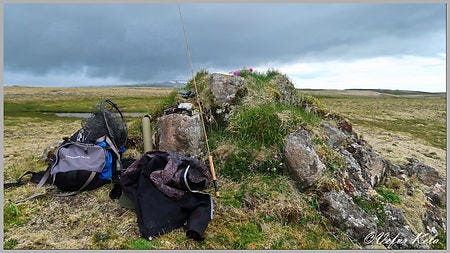
By this point in the hike, it was nearing 8:30 PM. Suddenly, a thick northern mist rolled in, and all landmarks vanished. I decided to stroll the short distance to Krókavatn, assuming it would be easy to find the car from there. I set off, choosing to follow a trail for safety, knowing one led east from Krókavatn toward Tangavatn. After walking for quite a while, I began to have second thoughts. I came across small ponds I thought were Krókavatn, but they weren’t. I kept going until the realization dawned on me: I was in trouble. I tried using Google Maps, but it was useless; the app just warned me that my location was difficult to pin down and the compass might be inaccurate. Now it started pouring again. I decided to backtrack along the trail. In a worst-case scenario, I’d have to wait there until the fog lifted, but I refused to leave the path. After some walking, I found a side trail I thought led to Krókavatn, but it led nowhere, so I doubled back. Finally, I found the right track to Krókavatn just as the fog cleared for a moment. I was immensely relieved. I tried fishing there without success and then headed up to the car. As I walked that final short stretch, the fog rolled back in. I think I’ll take this as a lesson learned and get myself an old-fashioned compass. That way, I won’t have to rely on battery-powered gadgets and satellite signals.