
The winter weather was exceptionally beautiful in Sæviðarsund when we set off just after noon. The sun was low in the sky, offering clear views from Reykjanes towards Esja, Akrafjall, Hafnarfjall, and Snæfellsnes. The sun was setting in the west as the plane took off around four o'clock. My wife and I were heading to Lisbon, the capital of Portugal. The spark for the trip was an invitation I received to an educational seminar held by the host school, English Matters. Guðrún came along on the trip, as we planned to explore the city together after the academic portion concluded. Despite it being a cold time of year in Lisbon, the weather forecast was good for our stay—a nice extension of summer was ahead. A little drizzle was predicted for the first day, but after that, it was supposed to be sunny with temperatures around 17°C.
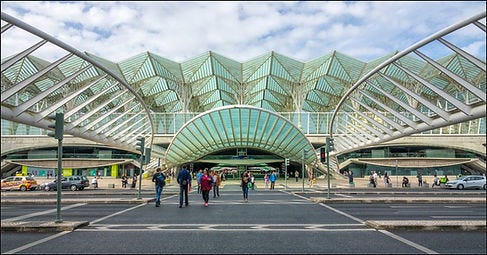
Beforehand, one would have thought there would be many remarkable things to see in Europe's second-oldest city; only Athens in Greece is older. The city has about 570,000 inhabitants, but the greater Lisbon area has three million. We stayed at the Hotel Melia Oriente, a four-star hotel just over seven kilometers from the city center. It was easy to get to the subway, so the distance from the center did not bother us. It was an added bonus that the Vasco da Gama shopping center was only a few minutes away. We intended to take the opportunity to do some shopping because the price level in Lisbon is much more reasonable than in our beloved Reykjavík.
The Seminar
My first day began with an introduction to the Portuguese school system at the hotel’s Expo Hall. After five hundred slides, I was nearly unconscious due to lack of air and information overload. However, I managed to grasp that the school system is divided into preschool for children aged three to six, and compulsory education for students aged six to eighteen. The compulsory period is divided into primary school and secondary school. Primary school is divided into three stages.
First Stage: For students in grades 1–4. The classes have one teacher who teaches all subjects. The main focus of study is the mother tongue, social studies, mathematics, and English. Occasionally, an assistant teacher comes in to teach subjects like arts.
Second Stage: For students in grades 5 and 6. In this stage, there is subject-specific teaching, and subjects like geography, history, and science are added.
Third Stage: For students in grades 7–9. Subjects like physics, chemistry, and a third language are added.
Secondary school is for students in grades 10–12. At this point, students can specialize according to their interests. There are three main tracks to choose from: Science and Humanities, Vocational Training, and Arts.
Schools in Portugal are either run by the state or are private schools. Education in public schools is free, except parents pay 30–50 Euros per month (approx. 4,200 – 7,200 ISK) for meals. Tuition fees in private schools are 60,000 – 80,000 ISK per month, plus meal costs.
One thing I find interesting is that parent-teacher conferences are rare in the Portuguese school system. If a student has specific problems, parents are referred to a psychologist and/or social worker. The school seems to focus more on learning and teaching, while leaving welfare-related matters to the health and social services, which truly belong to them. The reason I find this interesting is that a few years ago, I went to the Netherlands, and the approach seemed to be the same there. Back home [in Iceland], administrators and teachers are drowning in meetings involving parents and parties from the welfare sector, where the topic is welfare or health-related rather than learning or teaching-related. I am very doubtful that we are on the right path there and would much rather have seen the teachers’ time spent on organizing and developing instruction.
The air conditioning in the Expo Hall had apparently been adjusted better because the next part of the seminar was more tolerable. There was no longer a need to “breathe with a knife and fork” just to get oxygen. An entire morning was spent discussing in groups, analyzing what we had learned so far, and asking further questions about the Portuguese school system. During the discussions, there was time to compare notes and discuss the challenges the different countries are facing. That is always useful.
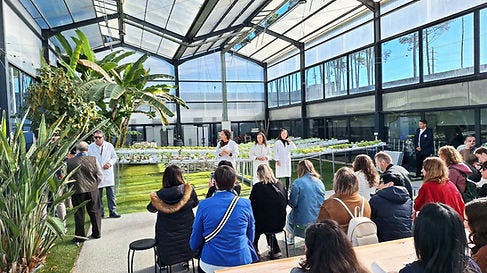
The third day began with a bus ride. We were heading to the Atlantica school. The Atlantica school is a 1,700-child school catering to students from babies in diapers up to 18-year-olds when their compulsory education ends. It was certainly interesting to visit such a large school, but I cannot say that much stuck with me. I have probably visited too many schools, and there was nothing that particularly caught my attention. Well, perhaps the filthy toilets and a massive greenhouse.
History and Culture
Praca dos Resturadores
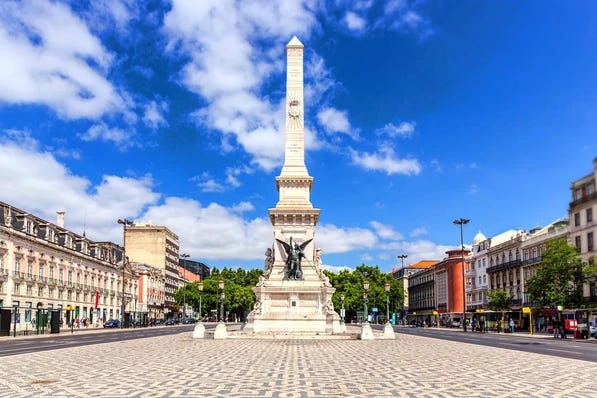
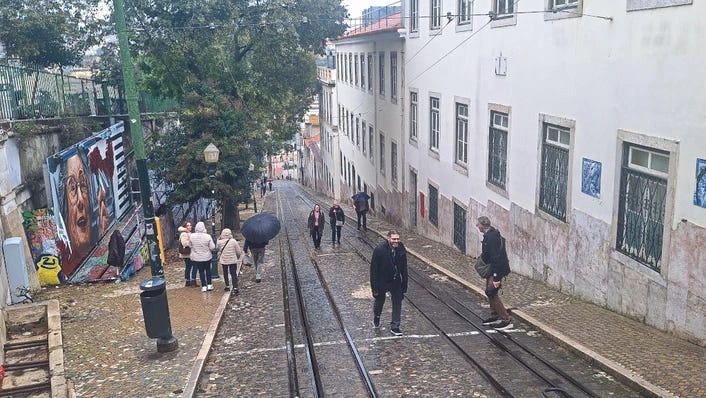
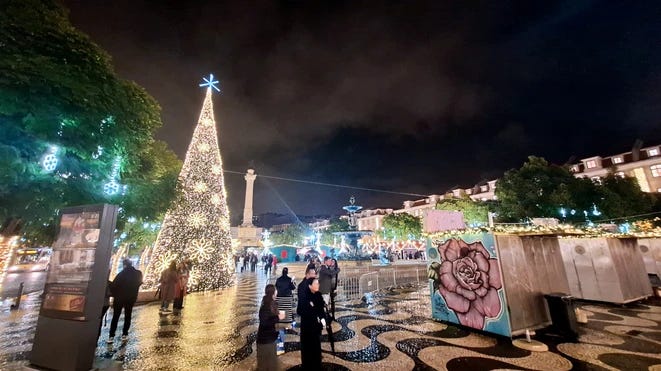
School matters were not the only knowledge English Matters offered. On Monday, we were invited on an afternoon guided walk around the city center. We met the whole conference group at the statue in Praca dos Restauradores, and from there, we marched off behind the guide, a delightful elderly woman. The square and its monument commemorate the restoration of Portugal's independence from the Spanish. Getting independence was not entirely painless, as the uprising began in 1640, and independence was not secured until 28 years later, in 1668. Knowledge like this flowed like a waterfall from this knowledgeable woman. I only managed to catch a fraction of what she said. The icing on the cake was supposed to be the view over the center of Lisbon from Portas do Sol. First, we had to climb the steep street where the famous tram number 28 had just tumbled down, with the terrible result that sixteen people died. The view turned out to be nonexistent because there was a lot of rain. When we were finished with the guide, we ended the day at the Rossio Christmas market, where we had cake, coffee, a waffle, and a beer. The knowledgeable woman had told us that the market stood in an area that used to be the edge of the city, where visitors to the city left their horses.
Fado Dinner
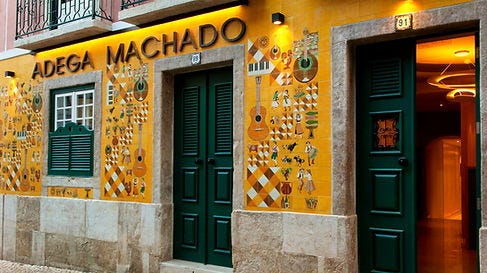
English Matters hosted a dinner at the Adega Machado restaurant in the Bairro Alto neighborhood on Tuesday night. The restaurant began operations in 1937, so it is not new. The menu is said to be national. I cannot say we remember the food very clearly, but the service was good, and it was particularly enjoyable to hear Fado music between courses. Since the food was provided by English Matters, we have no idea if it was expensive or not. Probably much more expensive than a traditional dinner, but that is natural because there was live music. Fado music could perhaps be called Portuguese blues, referring to the lyrics, which are characterized by resignation, sad fates, and longing. The music itself is nothing like blues. It is performed by a singer, a classical guitar, and a Portuguese guitar, along with an acoustic bass, often a double bass. The verses often alternate between major and minor keys, and the rhythm is often binary or ternary, like a waltz. Rubato is often used to give the music feeling. The bass keeps the rhythm steady, but the singer plays with stretching the tempo at the end of phrases to increase the drama.
The origin of this musical style has been traced to the Bairro Alto, Mouraria, and Alfama neighborhoods in Lisbon, and to the years 1820–1830. Performers mainly came from the working class. Sailors, concubines, bohemians, and poor artists performed the music, beat the rhythm, and danced to the music in the neighborhood taverns. As with most things that evolve slowly, like Fado music, it is difficult to trace exactly when the music began to be called a musical genre. No doubt the roots are much older than that.
Quinta da Regaleira
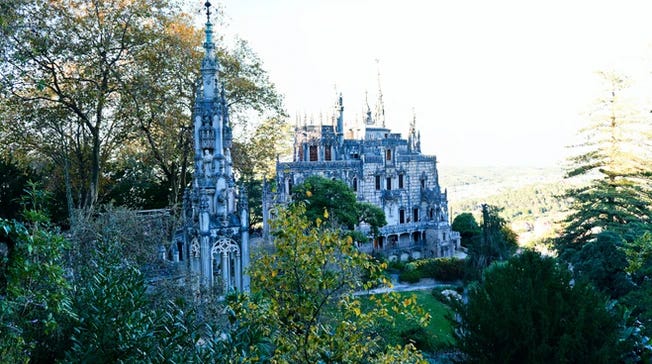
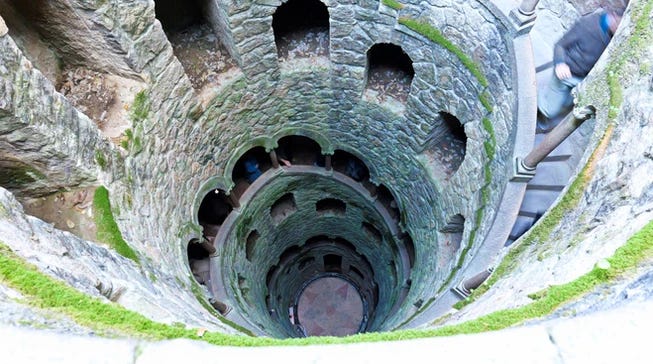
In the afternoon of the day we visited the Atlantica school, we were driven to the town of Sintra, where we strolled around a garden with old buildings. "Some garden" I say, because that was the feeling when we followed the guide around. I had not found the time to research what I was looking at, and that was probably why I did not enjoy the tour enough. Then I must admit that following a guide with a large group of people and fighting to hear the information they are rattling off are conditions that somehow do not suit me. Regardless, the area is called Quinta da Regaleira. In the area was a very ornate palace, a chapel, wells, and a garden filled with trees and walking paths. I found the history of the palace and the area not very interesting, because what remained in my mind was that this was a playground for the rich. That being said, it was beautiful there, and the 27-meter-deep "Initiation Well" sparked interest, but the purpose of building a waterless well into the ground is hidden from me.
There ended the program I was obligated to participate in, and Guðrún and I had the remaining time together. We used that time to explore this old city and shop. Yes, there is absolutely reason to shop in Lisbon because the price level is much
Vasco da Gama Tower and the Bridge
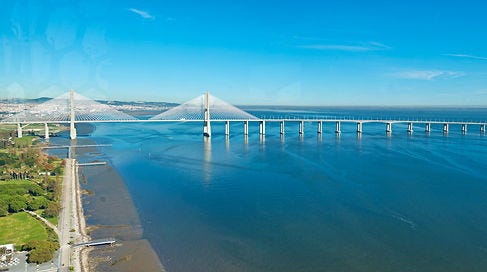
Not far from the hotel we stayed at, down by the Tagus River, is the Vasco da Gama Tower. The Portuguese have a significant history of exploration, and the tower is named after their most famous explorer, Vasco da Gama, who mapped the sea route from Europe to India. The tower was built for the Expo ‘98 exhibition. It rises proudly 160 meters and is the tallest building in Portugal. After the Expo, a purpose had to be found for this tower. Initially, it was meant to be rented out as office space, but that did not work out because no one wanted to rent. Now, the tower serves as a hotel. The first thing Guðrún and I did after I was free from my seminar duties was to go up the tower and look over the city. Not because we thought the tower was a notable place, but probably because it was within walking distance of the hotel and was the first stop of the Hop-on Hop-off bus, for which we bought a 24-hour pass to get a feel for the city.
From the top of the tower, you could see a massive structure that was also inaugurated in 1998, just before the Expo exhibition. Just like the tower, the bridge was named Vasco da Gama to mark the 500 years that had passed since his achievements. The bridge is 13 kilometers long and is the longest bridge in Europe. The bridge is built particularly strong, as it is in a known earthquake zone. It is designed to withstand wind speeds of 250 km/h and last for 120 years. An amazing structure, I must say.
Torre de Belém and Padrão dos Descobrimentos
There are many notable things to see in the Belém neighborhood. The district is in the western part of Lisbon. To get there, we took bus number 728 from Gare de Oriente train station. It would have been absolutely perfect to jump off the bus at the Belém Tower, stroll east to the monument, and then north to the monastery. We did not do that because the tower was closed and packed with scaffolding when we were traveling there. Instead, we got off at the monument and looked at the tower from a distance. It was built between 1514 and 1519 at the behest of King Manuel I of Portugal. The purpose was to strengthen the defenses of Lisbon and manage ship traffic on the Tagus River. During the years the tower was built, the Portuguese were beginning their age of discovery. The tower has later also served as a prison and as a lighthouse for sailors.
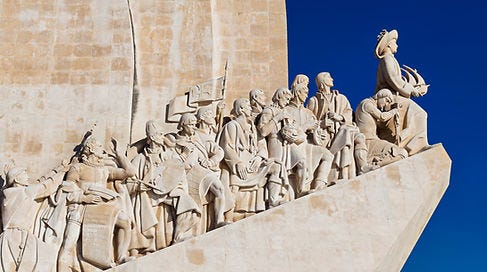
A little further east on the north bank of the Tagus River stands the Padrão dos Descobrimentos, or the Monument to the Discoveries. It was built in 1960 to commemorate the 500th anniversary of the death of Dom Henrique, the first known explorer. He stands at the forefront of the monument's prow, followed by various well-known figures from the era of exploration, 32 in total. While we were wandering around the monument, I was stopped by students who were working on a school project about the tourism industry in Portugal. They wanted to know what I found most remarkable about what I had seen in Lisbon, and I could think of nothing else to say but the friendly demeanor of the people and the good food.
Jerónimos Monastery
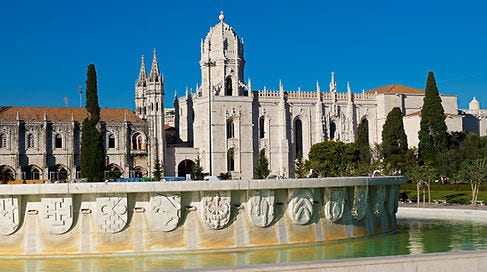
We walked across the street at the monument towards a magnificent building. The building stands in exactly the same place where Vasco da Gama and the sailors of his fleet prayed before sailing to India. The building is called the Jerónimos Monastery and was built at the same time as the Belém Tower. Previously, a church stood there dedicated to Holy Mary of Belém, and it is precisely a statue of her that stands over the entrance to the monastery. Above everything towers a statue of the Archangel Michael. We only explored this amazing building from the outside, and honestly, I regret not choosing to explore the monastery museum rather than the maritime museum at the end of the monastery building.
Maritime Museum
On our second-to-last day in Lisbon, we made another trip to the Belém neighborhood. This time to explore the maritime museum. We chose it because of the remarkable maritime history of the Portuguese. We regret it a little because the maritime museum is basically an endless collection of ship models of different types. One would have thought it was possible to honor this significant history better and in a more interesting way than this.
Praca do Rossio
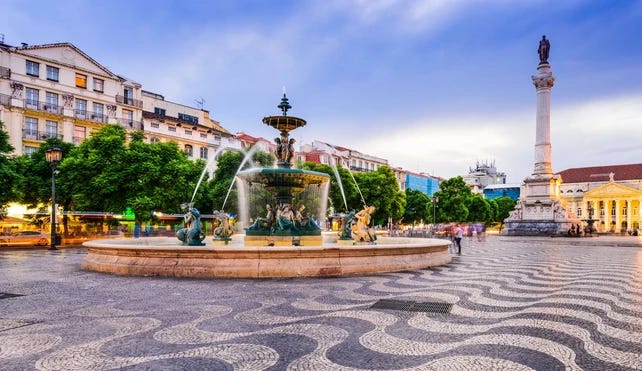
Rossio Square is actually called Praça de D. Pedro IV, whose statue towers 27 meters above the square. Dom Pedro is known as the Soldier King. He was born in Lisbon but fled with his family to Brazil due to the French invasion in 1807. His father returned to Portugal in 1821. Pedro remained in Brazil. He supported rebels in Brazil’s independence struggle and became king there from 1822–1831, and then king of Portugal in 1826. Rossio Square became an important gathering place in the 13th and 14th centuries and therefore has a long history. The term Rossio refers to the common people, and its name could therefore be interpreted as the “People’s Square” in Icelandic. Originally, the square was a gathering place for the people when the city expanded from the castle area. In 1450, the Estaus Palace was built at the end of the square. That palace was a residence for important people visiting Lisbon. The knowledgeable woman who took us on the walking tour said that the guests’ horses had been kept in the square. When that horrible institution, the Portuguese Inquisition, was established in 1536, the palace at the square became the headquarters of the court, and the square was often used for public executions. The houses around the square then largely collapsed in the earthquake of 1755. The Estaus Palace was rebuilt, but it then burned down in 1836. Another remarkable building stood at Rossio Square: the National Hospital. The construction of the hospital was completed in 1504.
We came into Rossio Square several times during our wandering around Lisbon. The buildings we saw were, of course, reconstructions made in the wake of the earthquake. Otherwise, we did not see the square in all its glory because the square is still the main gathering place for the city’s inhabitants. Every year, a Christmas market is set up in the square, so the square was covered with sales booths.
Parque de Eduardo VII
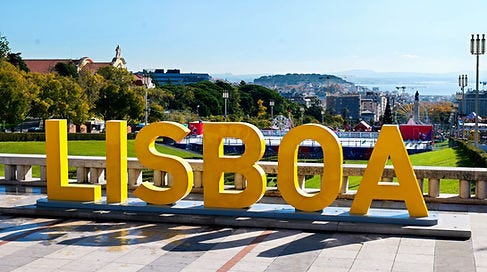
One day, we got off the bus at one of the highest points in the city. We were at the top of Eduardo VII Park. This park was once called Liberty Park, but in 1903, a British king visited, and the name of the park was changed. The Portuguese clearly felt it necessary to keep the British happy. There was a great view from the fountain at the top of the hill to the south over the square of the Marquis of Pombal and further down to the Tagus River. A great view there. We strolled down the hill, through a Christmas market that was being set up.
In the middle of the square stands a massive statue on a column of the Marquis of Pombal. He was the prime minister of King Joseph I of Portugal. The king gave him free rein, which allowed him to become the most powerful man in Portugal. He was apparently a terrible “skíthæll” [jerk] this man, but it cannot be denied that he was extremely industrious and accomplished several good things for Portugal. He is best known for organizing and driving forward the reconstruction of Lisbon after the earthquake that struck Portugal on November 1, 1755. It was a horrific earthquake. How large it was is clearly not entirely clear, around 8.5 - 9 on the Richter scale, and after the earthquake, Lisbon was almost entirely in ruins. Eighty-five percent of all buildings in the city either collapsed, burned, or fell victim to a tidal wave. It is estimated that 30,000–40,000 people died out of the 200,000 who lived in Lisbon. “What do we do now?” Pombal was asked, and with icy realism, he answers: “We bury the dead and treat those who lived.” Then the reconstruction work began with great vigor, and now the houses were built with awareness of the danger of earthquakes.
Praca do Comércio
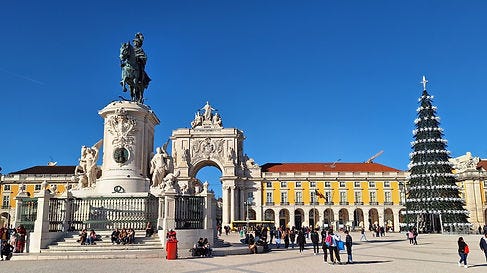
By the Tagus River is a massive square. This square is located where the Ribeira Royal Palace formerly stood. That palace collapsed to its foundations in the earthquake, like other houses in the area. Therefore, the entire area had to be redesigned. Now, the main government institutions of Portugal are located at the square. In the middle of the square is a large statue of Joseph I, who was King of Portugal when the great earthquake struck. He was incredibly lucky that day because his daughter had wished that the royal family would stay in the summer cottage, which was a palace in the Belém neighborhood on the outskirts of the city. Poor Joseph was quite shaken in the wake of these misfortunes and preferred to live in a tent, which he did. That is probably why the Ribeira Palace was not rebuilt. Behind the statue of Joseph is the Arco Triunfal da Rua Augusta, or the Triumph Arch. If you walk under the arch, Augusta Street takes over, and if that street is walked to its end, you end up in Rossio Square.
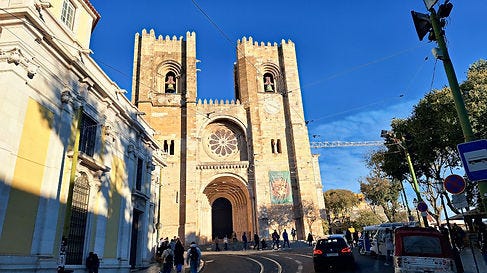
We stumbled into Praça do Comércio when we were looking for the cathedral. We actually got into complete confusion in that search because the navigation system sent us on a bus that took us up to Breiðholt [a suburb of Reykjavík]! We solved that mess by ordering a taxi that drove us to the city center. In the end, we found the cathedral, which was just up on a hill a short distance from the square. The cathedral was built in 1147, so its history spans well over 800 years. Its appearance bears the mark of the Middle Ages. It reminds one a bit of a castle from the Middle Ages. Certainly, additions have been made to it, and more or less repairs have been needed over the centuries due to damage from earthquakes. The earthquake of 1755 was the largest, but it was by no means the only one.