
"Shortly after my wife and I booked an autumn trip to Berlin, I received an offer to attend a seminar in Madrid. The offer was actually too good to refuse, so I jumped at it, and my wife tagged along. The seminar was for a group of school administrators who have been hosting groups of teachers and managers on behalf of English Matters. English Matters is a department at the University of Madrid that organizes various courses and trips for educators. The trip was funded by the Erasmus+ project, so we did not have to pay for accommodation, and I received a grant for the flight from the Teachers' Union, meaning the cost of a week-long trip to Madrid was only my wife's airfare."
Madrid
Madrid er næst stærsta borg Evrópu. Íbúar eru 6,7 milljónir með úthverfum en í megin borgarkjarnanum búa 3,4 milljónir. Borgin er staðsett á miðjum Íberíuskaganum uppi á hásléttunni í 650 metra hæð. Þess vegna einkennist veðurfarið af heitum sumrum og köldum vetrum. Köldum vetrum? Varla því við vorum þarna í næst kaldasta tíma ársins og veðrið var allan tíman eins og á góðu sumri í Reykjavík. Madrid hefur verið höfuðborg Spánar frá 1561. Hún er heillandi borg vegna þess að vel hefur tekist að halda í gömlu byggingarnar.
Puerto de Toledo
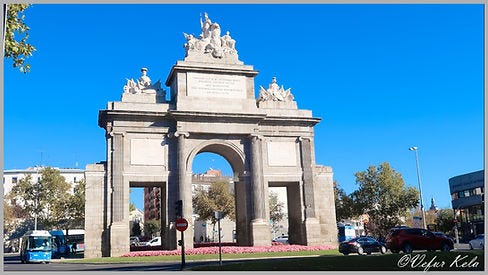
The first place to receive special mention here is not actually one of those places in Madrid that warrants a special trip just to see it. However, we did not need to make one, as we stayed at a hotel of the same name located right next to the Toledo Gate (Puerto de Toledo). Right by the hotel is a metro station with the same name. Joseph Bonaparte initiated the construction of the gate in 1812, but the French left Madrid a year later. Construction continued regardless, and the gate was completed and ready for use in 1827. At the time, this nineteen-meter-high gate served as the entrance for those arriving in the city from Andalusia. Today, the gate is nothing more than decoration on a roundabout.
Plaza Mayor
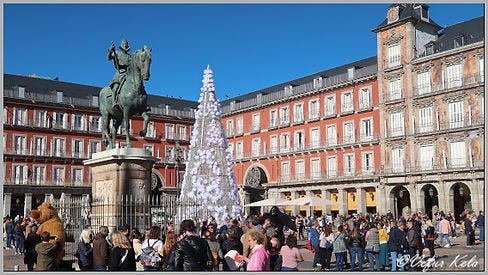
The Plaza Mayor is the main square in Madrid. It was inaugurated in 1620 at the behest of Philip III, whose statue stands in the center of the square. The square is perfectly rectangular and relatively enclosed. Narrow exits lead out in all directions, and there is a multitude of restaurants in the square. In reality, there is not much to see in the square itself. The main buildings are the Casa de la Panadería with the frescoes on its facade, and the Casa de la Carnicería. Throughout its long history, the square has been the venue for various events, including bullfights and even executions.
Plaza del Sol (Puerta del Sol) is another square worth visiting in Madrid. This square is supposedly the center of Spain, and it is therefore said that all roads within Spain lead to this square. The main squares of Madrid are not far apart. We understand that Plaza del Sol is a beautiful square and that the famous statue of the symbol of Madrid, the strawberry tree and the bear, is located there. We will have to make another trip to Madrid to see this square, as it was closed for renovations.”
Gran Via
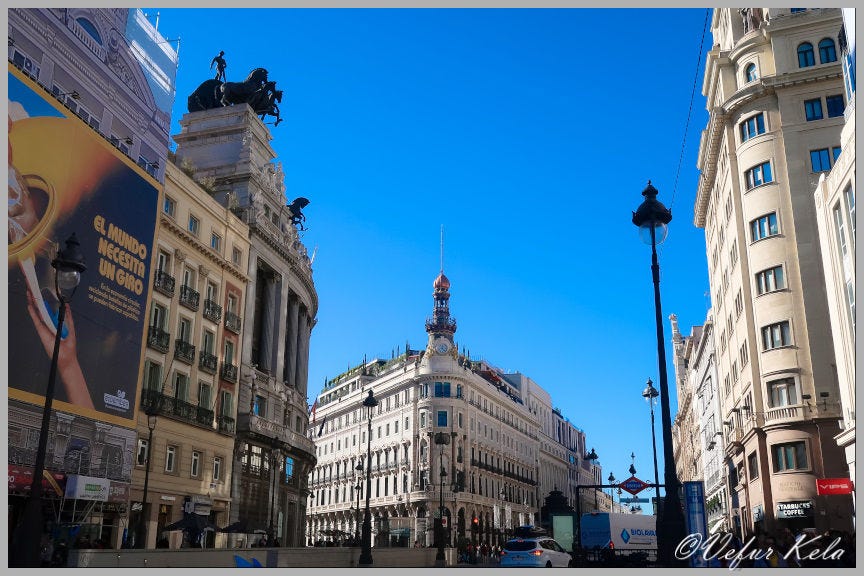
Since we were traveling in Madrid and Christmas was not too far off, we took the opportunity to do our Christmas shopping. Prices are much better in Spain than in Iceland, so it was a no-brainer. The main shopping street is Gran Vía, and we cruised up and down it. Gran Vía is Madrid's most famous street. The first designs for its layout were drawn in 1869 when the city center of Madrid was being redesigned. It took the people of Madrid some time to finalize it, as the design work was not completed until 1899, and the construction was not fully finished until 1929. This is not surprising, given the scale of the project. To lay the street, 300 houses and 50 streets had to be demolished. Gran Vía is quite impressive, adorned with many stunningly beautiful buildings. The street is home to numerous theaters and cinemas, hence its nickname, the 'Broadway of Spain.' However, the number of theaters and cinemas has decreased slightly in recent years.
Cibeles square
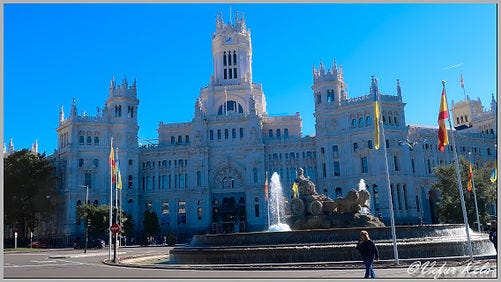
Eftir að hafa gengið Gran Via til enda og smá spöl eftir Calle de Alcalá komum við inn á Cibeles torgið. Magnað torg þar sem Cibeles brunnurinn og samskiptahöllin eru mest áberandi. Samskiptahöllinn eða Palacio de Cibeles var byggð árið 1919 sem pósthús en þjónar í dag sem ráðhús Madridarborgar. Við torgið eru fleiri merkar byggingar eins og Palacio de Buenovista, Banco de Espania og Palacio de Linares.
The Royal Palace and the Cathedral
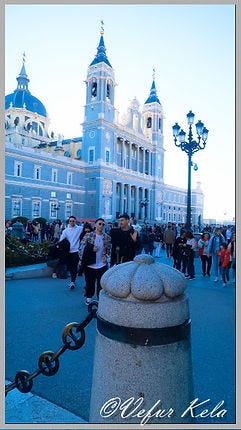
"If there is a royal palace in a city, it is, of course, a tourist's duty to visit it. We therefore strolled into Plaza de la Armería, where the Royal Palace is on one side and the Almudena Cathedral on the other. The Royal Palace, one of the largest palaces in Europe, was built between 1738 and 1755 in the Baroque style. When the Moors took full control of Spain, they built an alcázar, or castle, on the hill where the palace now stands, as the location offered panoramic views in all directions. It was Emir Muhammad I who initiated that construction, which rose between 860 and 890. The castle expanded over the centuries, with the largest additions made in the latter half of the 16th century. For a long time, the building retained the castle name (Alcázar) despite having become a royal palace. In fact, little is known about this building, as hardly any drawings of it have been found, except for one from the 16th century."
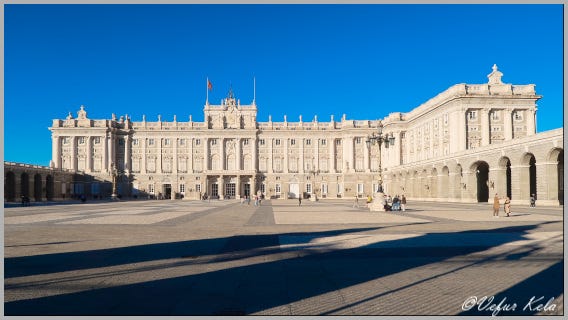
Það kveiknaði í gömlu höllinni 24. desember 1734 og fjórum árum síðar að skipan Filips V hófst bygging nýju hallarinnar. Sú höll er engin smásmíði. Hún er ein sú stærsta í Vestur Evrópu. Herbergin eru 3.418 í 135 þúsund fermetrum. Almenningur getur fengið að fara skoðunarferð innan hús. Við ákváðum að gera það ekki. Eiginkonan sagði að hún hefði séð nóg af höllum.
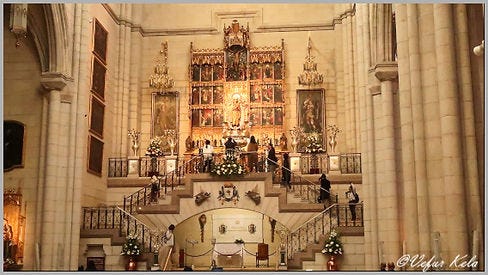
Beint á móti innganginum í höllina er dómkirkjan, Cathedral Almudena. Glæsilegt hús og með fallegri kirkjum sem við höfum séð. Maður myndi ætla að í borg eins og Madrid ætti dómkirkjan sér langa sögu en svo er nú ekki. Bygging hennar hófst árið 1878 en hún var ekki vígð til notkunar fyrr en 1993. Vissulega eru margar gamlar kirkjur í Madrid en dómkirkjan er ekki ein af þeim.
El Retiro garðurinn
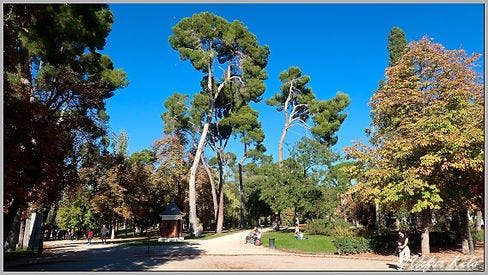
Retiro Park is the main public park in Madrid. The park is generally bustling with life, and there is always something fun going on. Various artists perform their art here and there throughout the park. There is a man-made lake where you can go boating, a monument to Alfonso XII, the Crystal Palace, a rose garden, art exhibitions, and more. Naturally, we took a stroll through the park. Probably not much was happening, as November is an autumn month. Nevertheless, we were looking at blooming roses in Retiro Park, and the temperature during these November days was like a good summer day in Iceland. Despite not much going on, we happened upon a classic car show, and there was some fun activity for children.
Prada museum
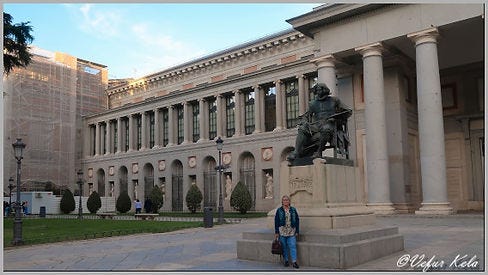
"One evening, we spent two hours at the Prado Museum. In that time, we naturally only saw a tiny fraction of the collection. The museum actually owns 7,600 paintings, 4,800 drawings, and 1,500 sculptures. Admittedly, the entire collection is not on display at once, but plenty is exhibited regardless. One simply does not have the attention span for a visit longer than two to three hours. Old Eduardo, who invited me to Spain, turned out to be a great enthusiast of art and history, so we received absolutely fantastic guidance through the museum, especially regarding the works of Velázquez, Goya, and El Greco. Since photography had not yet been invented when these gentlemen were active, they were essentially the photojournalists of their time, so we received guidance not only on the art but also on history."
School Visit and Toledo
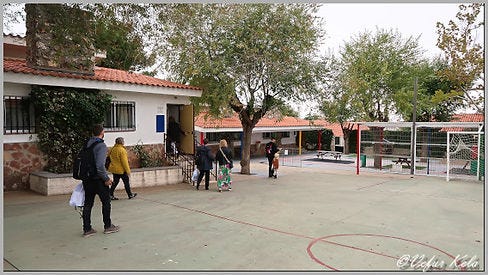
Since the trip was work-related, part of the time was spent sitting in a seminar with school administrators who host groups on behalf of English Matters. We also visited a school with approximately 700 students. The school is called Eurovillas International School, and they place great emphasis on English instruction. According to what Eduardo told us, it is official policy in Spain to place strong emphasis on teaching English. One hardly noticed the size of the school because it consisted of many small buildings rather than one large one, as we are accustomed to in Iceland. The classrooms and furniture were far more modest than what we are used to in Iceland.
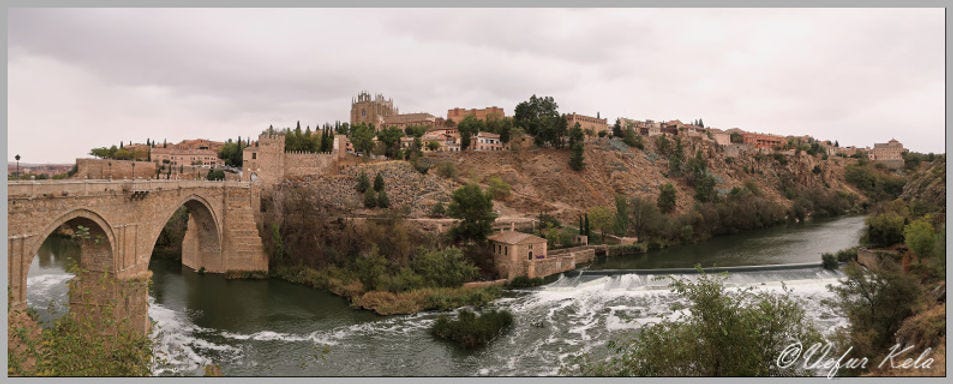
In the latter part of the day, we stopped in the city of Toledo, which has a long and remarkable history. It was probably originally chosen for this rugged landscape because of how well the city is naturally protected from attacks. The Tagus River protects it from three sides, and it is situated very high up, over 1,100 meters, so it would not have been easy for invading armies to approach the city unseen. The city is mentioned in Roman records as a small city protected by its location (urbs parva, sed loco munita). The city was conquered by the Roman general Fulvius Nobilior in 193 BC and became the capital of Carpetania. The Visigoths established their court in the city in the sixth century, and it also became important during the Moorish period from 712 to 1085, when Alfonso VI conquered the city. An interesting part of this city’s history was how Muslims, Christians, and Jews managed to live together in peace and harmony for centuries. There is likely something to be learned from that. The city’s importance decreased significantly when Philip II made Madrid the capital of Spain in 1560.”
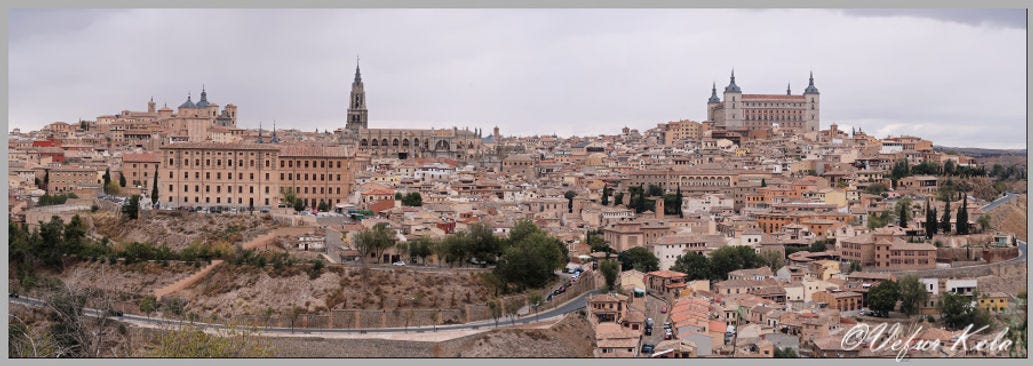
We received a guided tour of the city center, where an incredibly entertaining guide poured so much knowledge over us that one can remember very little of it. We do, however, remember her telling us about last year's extreme weather. The Spanish are accustomed to fairly mild winters, but up there in the mountains, an unusually powerful cold snap brought temperatures down to 25 degrees of frost, bursting their water pipes. Then came the summer, and the heat was unbelievable. The Spanish are used to temperatures exceeding forty degrees every summer, but the guide described last summer as pure hell. During the day, the temperature rose well above 40 degrees, but what was unusual was that it did not drop below 27 degrees at night. Consequently, the residents did not get any relief in their homes in the morning.
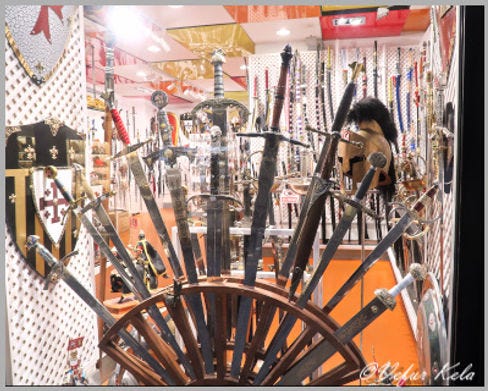
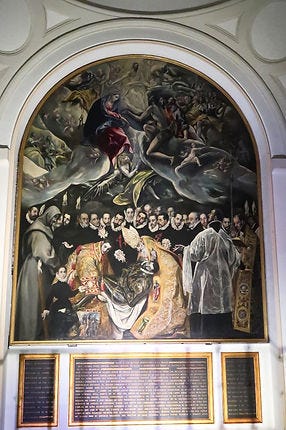
One of the things we remember from the guide's narrative was the story of a famous painting by the master El Greco, which he painted in a chapel by the cathedral. The painting is called 'The Burial of the Count of Orgaz'. That distinguished man governed the city and passed away in the first or second decade of the 14th century. He was clearly highly regarded because the story goes that two saints descended from heaven to bury the man. The painting is divided in two, with the upper half depicting what is happening in heaven, while the lower half shows what is taking place on earth. Naturally, you can find El Greco himself in the painting, as if he had been present when the event occurred. That can hardly be true, however, as the painting was painted in 1586. On our walk through the city center, we saw one shop after another selling swords, knives, and various iron goods. Toledo is specifically known for its high-quality steel and the production of knives and swords.
Ávila
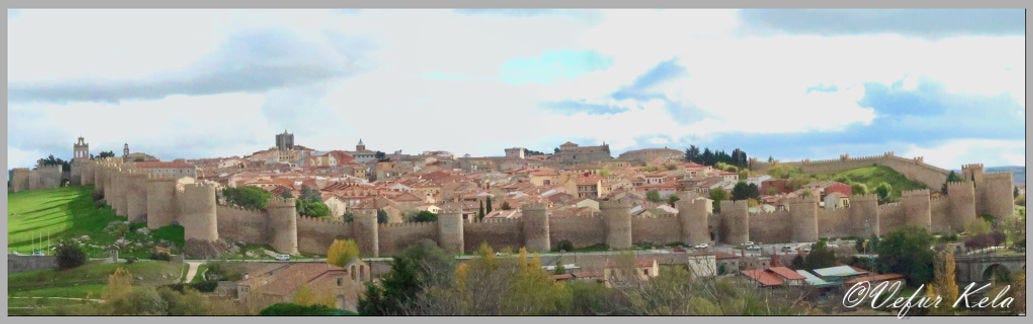
The managers of English Matters clearly wanted to treat us well, as we have been hosting groups from them. One day, Eduardo and Eduardo—yes, there are two of them—organized a day trip that was strictly for sightseeing and exploring Spanish culture. We started by visiting the town of Ávila, which, like Toledo and Madrid, is located on the high plateau of Spain. The town is a UNESCO World Heritage Site. The old town is surrounded by a well-preserved defensive wall. Construction of the wall began in the 12th century. The largest part was built in the 13th century, but it took a full 600 years to complete the entire wall. The wall is 2,500 meters long, 12 meters high, with 88 towers and 9 gates. A truly impressive structure and incredibly well-preserved.
Segovia
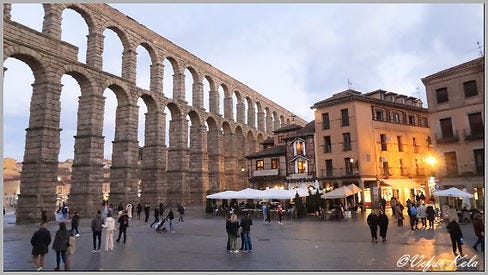
After the visit to Ávila, we went to the city of Segovia. Segovia is a city of approximately 60,000 inhabitants and is best known for its well-preserved ancient structures. A magnificent Roman aqueduct runs through the city center. It is believed to have been built towards the end of the first century AD. The aqueduct is built of stones, with no mortar holding them together. It levels out the differences in elevation of the landscape and transports water from the Río Frío river, which is 17 kilometers from the city. The aqueduct was in use until 1973. An absolutely magnificent structure and incredibly well-preserved. We had a very late lunch next to this structure. It was sorely needed, as the group was starving.
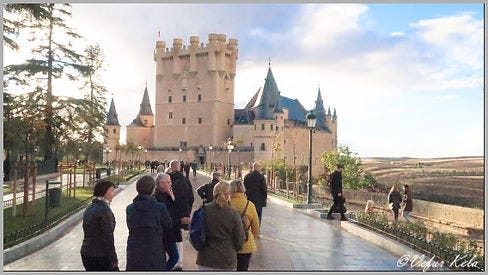
"After lunch, we took taxis from the restaurant up to the Alcázar de Segovia, a castle built in the late Middle Ages. The appearance of this castle is very unique, as the architecture is a blend of European (Gothic) and Muslim (Mudéjar) influences. The castle feels as if it were cut straight out of a fairy tale. Possibly because it is, in all likelihood, the model for Snow White's castle at Disney. The castle is built on a rocky outcrop, and it is known that the Romans built some kind of military installation on the rock. The Moors built a fortress on top of the Roman ruins. The first records of a castle on the rock are from the 12th century, shortly after the Christians gained control of the area. The castle has a rich history that can be read here. To make a long story short, the castle has served as a fortress, a royal palace for 22 kings, a royal military academy, and a state prison."
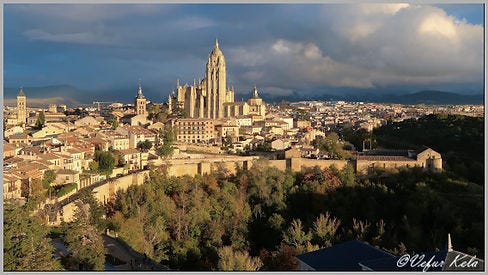
We did not visit the cathedral, but it is surely worth seeing. At the very least, it looked magnificent from the castle. The church was built between 1525 and 1577, and the dome was added in 1630.
Las Ventas and Various Other Things
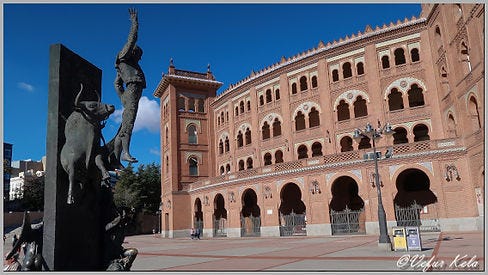
In addition to the aforementioned places, we wandered around Madrid, as there is, of course, a great deal to see in this wonderful city. We took the time to do our Christmas shopping on Gran Vía. For instance, the second-largest Primark store in the world is located there. A remarkable fact, or something like that. One day, we visited Las Ventas, which is the third-largest bullring in the world and the largest in Spain. Truth be told, we were not very impressed. Our negative attitude toward bullfighting probably plays a role in the experience. However, our overall experience of Madrid was nothing but positive. The transportation is excellent, and there is much to see. If we were to get the urge for a city break in the near future, Madrid would certainly be under consideration. A week in the city would be an appropriate amount of time, and we would absolutely recommend that travelers take day trips out of the city to Toledo, Segovia, and Ávila.