
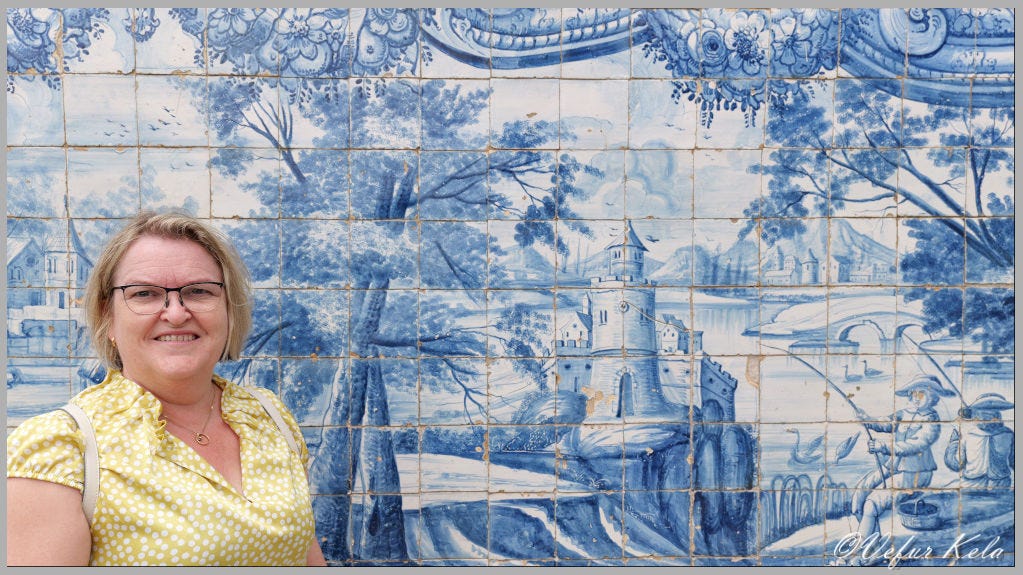
This is the second time my wife and I have stayed in the city of Porto in Portugal. The last time was an company anniversary trip with her work in 2018, but this time it was a study and familiarization trip with Breiðagerðisskóli. Saturday was just a travel day. We arrived at the Mercure Porto Santa Catarina hotel, where we stayed until dinner. The hotel turned out to be quite excellent. Wonderfully well-located in the city center, the staff was friendly, and the breakfast was good. The bread was particularly good. The only thing we wished was better was the room, which was uncomfortably narrow and had very little storage space. On this first day, we popped into the restaurant next to the hotel, where we had cod before going to sleep.
When we stepped out of the hotel, the Church of Saint Ildefonso greeted us. The church is located near Batalha Square. A chapel used to stand where the church now stands. The oldest records of the chapel date back to 1296. The chapel was close to collapse and was demolished in 1709, and work began on building this beautiful church in honor of the bishop of Toledo. The church was then consecrated in 1739. The blue tiles give the church a beautiful appearance, and tile decorations like these can be seen on houses throughout Porto.


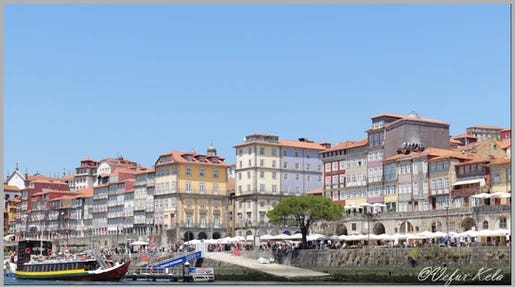
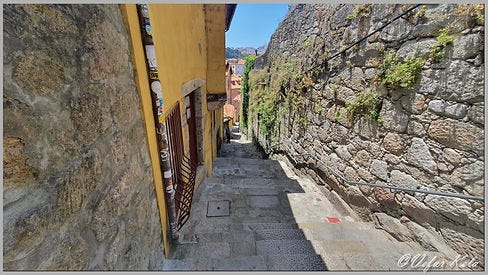
Otherwise, Sunday was just used to wander aimlessly around the hills in the vicinity of the hotel. Porto is really not a city for those with weak legs, because you are either rolling down the hills or exerting yourself pulling yourself up them. This was fitness provided by Porto, and we feel our physical condition has improved after a week’s stay in the city. We then strolled to one of Porto’s main landmarks, the Clérigos Church with its 75-meter-high tower. It is possible to buy access to the church and the tower and enjoy a magnificent view from there. We decided to skip that. Construction of the church began in 1732 and was finally completed with the tower in 1763. This church is in Baroque style, designed by the Italian Nicolau Nasoni. Next, we rolled down to the Ribeira district by the Douro River, but apparently, you should avoid buying drinks or eating there. The reason is the price level, and they probably aren’t the best restaurants.
We then pulled ourselves up the hills back towards the hotel. We were getting thirsty. A flowering Jacaranda tree charmed us, so we sat down at a restaurant that offered a view of this beautiful tree. These trees originate in South America, but they have been planted in many places, as they are very beautiful.
A stone’s throw from the hotel is Santa Catarina Street, which is the main shopping street in Porto. We grabbed one suitcase on the way home because we only had one left after my suitcase was ripped to shreds during a trip to Rome a few years ago. On the way, we stopped at a pizza place where we had quite good pizza.
According to Monday’s schedule, there was supposed to be a course held in the town of Aveiro, which is a town of about 80,000 people 75 km south of Porto. It took us about an hour to get there by train. There was not much training held because the trains started running later that day. The reason is that the day is a national holiday in Portugal—a public holiday. The tenth of June was chosen because Luís de Camões died on this day in 1580. This Luís is a kind of icon of Portuguese national consciousness. He was a poet and composed the poem Os Lusíadas, which is a poem praising the achievements of the Portuguese.
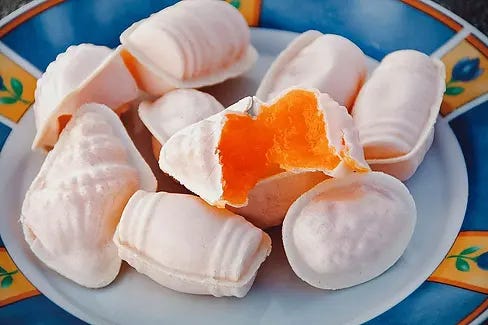
So we experienced what Aveiro has to offer, which is perhaps not all that much. I suppose the beach is the main attraction in that town. We were not lucky with the food we bought in this town. It was just not good at all. Yes, the pastry Ovos Moles tasted good. After we finished the course, we sat down, I think by the town hall square. One of us dashed into a bakery nearby and came back with the town pastry called Ovos Moles, which would translate as "soft eggs." Ovos Moles is made from eggs, egg yolks, sugar, and sometimes chocolate. Legend has it that Ovos Moles originated with nuns of the Franciscan and Carmelite orders, who used the whites of eggs to clean their habits and had to find a use for all the leftover yolks. Ovos Moles tastes quite good.
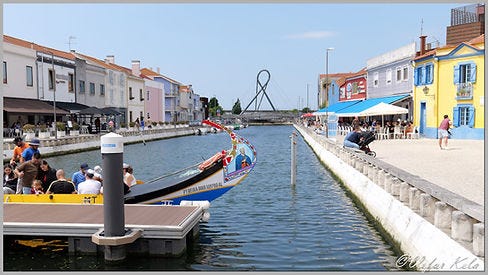
The town has sometimes been called the Venice of Portugal because it is intersected by canals, and we sailed along these canals. The boat trip was fine in its way, but there wasn’t really much to see. The train station is beautifully decorated with blue tile pictures, and the city center was cute, but the people of Aveiro did not manage to charm us with the food they offered.
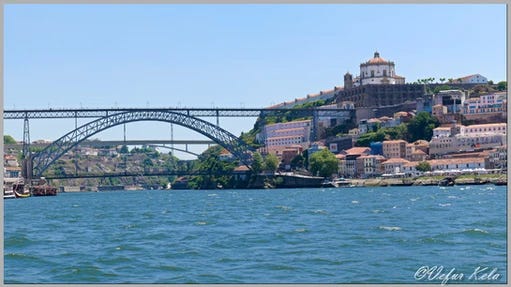
One boat trip is not enough, so we went on another one on Tuesday. We bought a guided boat tour on the Douro River. The Douro River is the third longest river on the Iberian Peninsula and is 895 kilometers long. We only sailed on the lowest part of the river and got another perspective on the Dom Luís I bridge and the Ribeira district. We had the whole day free, except we had decided to participate in a wine tasting trip in the evening. Perhaps we should have skipped that because that trip was a repetition of a trip we took in 2018. The main thing to remember from this trip is that it is not enough for guides to have a good vocabulary in the English language. It is better if what they say is understood. All that knowledge that flowed from the guide’s lips passed me by because I did not understand a word of what she said. The boat trip earlier in the day was rather more interesting, and that guide was easy to listen to.
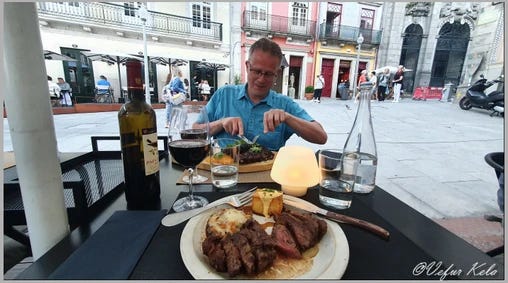
On Wednesday, I attended to my duties and visited a school and a library. Those visits are not really worth telling stories about, but Guðrún used the time to shop because prices are somewhat lower than in Reykjavík. Rua de Santa Catarina is the main shopping street in Porto and conveniently close to the hotel we stayed at. Just around the corner. In the evening, we had the best meal we had on this trip. It was by a busy square, and there were always brilliant musicians playing at the square. We stopped a few times at this square on our walks around the city and sat inside three of the restaurants there. Otherwise, we were not disappointed with the food we got on this trip. Actually, it varied, but that is to be expected when you haven’t prepared at all and just drop in wherever you are at any given time.
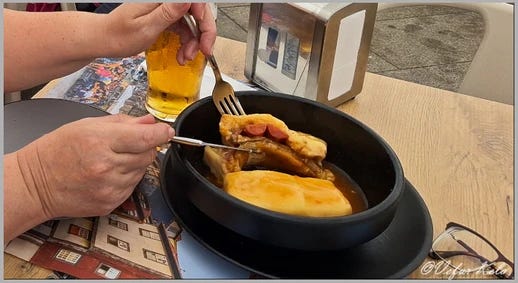
We understand that you shouldn’t eat in the Ribeira district because the food is most expensive there, but not necessarily the best. We verified this because we once had lunch by the riverbank and drank beer with it. This was the most expensive glass of beer of the trip, and it was probably a mistake to choose this place to taste the most popular Portuguese sandwich. The sandwich is called Francesinha, which would translate as “little French girl” in our native tongue. The sandwich is composed of white bread, ham, steak, egg, cheese, and a lot of sauce mess. We do not recommend this sandwich at all, except to be able to say you have tasted it.
We decided to go to the Crystal Palace Garden (Jardins do Palácio de Cristal) on Thursday. We found no Crystal Palace, but it was apparently there before 1951. It had been built for some world's fair in 1865 but was demolished in 1951. The Crystal Palace was built in the spirit of the eponymous palace in London. The reason the palace was demolished was that it was not maintained and fell into disrepair. In its place, a green dome was built, sometimes called the "green spaceship." The role of the green dome is to be an event hall. We got a guided tour of the hall, but our purpose was mainly to see the view over Porto from the top of the building. It was fantastic and well worth seeing.


We made a trip to the Arrábida shopping center on Friday. This shopping center is in Gaia, and for some reason, it is not mentioned when you search the wisdom of the World Wide Web asking about shopping centers in Porto. However, it is among the better ones because there is no shortage of shops, with over 180 of them, nor seats for shopping-weary husbands.
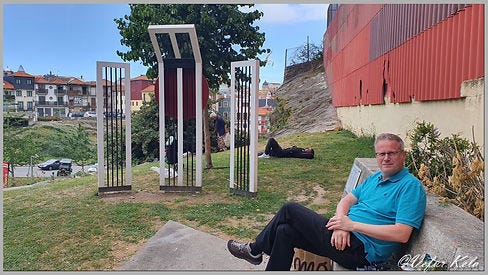
Saturday was the day to go home. We started by sitting down by some monument on one of the hills to eat the packed lunch, which was just the leftovers of what was edible in the hotel room when we checked out. As we sat there, an old woman comes along who had a very hard time walking and pulls some food scraps out of a bag. Then two wild cats appear that clearly knew the woman. Shortly after, the seagulls appeared, and they are quite pushy. The old woman was not happy with them, but she ensured with screams and staff-waving that the cats got their share.
We didn't have a flight until later in the afternoon, so we could give ourselves time to visit the cathedral. Its construction began in the middle of the thirteenth century, and it has gradually expanded through the centuries. Otherwise, we have visited so many churches on our travels that there was nothing special about the cathedral in Porto that gripped us. Except perhaps the blue tiles that can be found widely in Portugal. These tiles are called azulejo and can be traced back to the fifteenth century and influence from the Arabs. These blue tiles decorate many houses in Porto. In the high school I visited, I saw that propaganda against vandalism was being run. On a wall in the lobby, I saw that one of the things causing trouble is the theft of tiles. Thieves chop tiles off houses, and then they are bought and sold. Another thing that characterizes Porto is the hills. The city is certainly not for those with weak legs.