River Norðurá August 12th - 14th, 2022
Eight salmon, two of them big, six small, and a swim in Ferjuhylur.

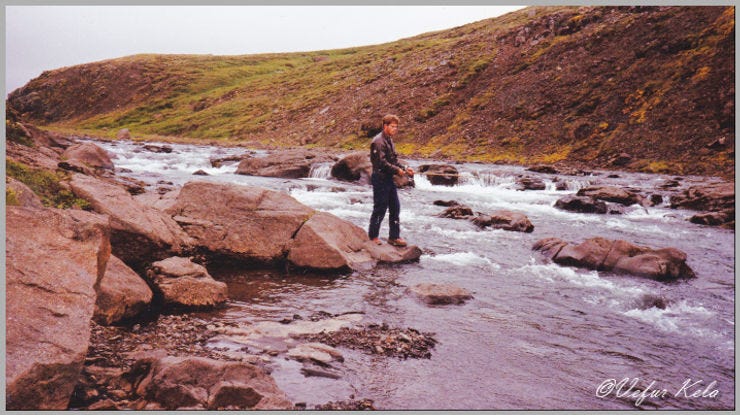
My fishing blog bears witness to the fact that my usual hunting grounds are primarily lakes and the prey is trout. The reason is the price of salmon fishing permits, as there is certainly no lack of interest. However, my wife and I finally decided to go for it and bought permits for the uppermost beat of the Norðurá river last week. Norðurá is one of the best salmon rivers in the country and flows right past our cabin in the countryside. It’s actually quite remarkable that we haven’t made it a regular event to fish there.
While we certainly know where the notable casting spots are, we have little idea where the fish actually lie. Such knowledge only comes with experience. The fishing area stretched from Símastrengur, just below the farm Háreksstaðir, up to the bridge pool at Fornihvammur. This is the highest section of the river, often referred to as Norðurá – The Mountain (Fjallið). Three rods are sold for this beat, and we had all of them in partnership with my wife’s cousin, Stefán, and brother-in-law, Maggi.
Twice before, I have cast a line in Norðurá. The first time, it so happened that Dóri Nikk—a former river warden and my wife’s cousin—showed up at our cabin door up in the valley and said to my father-in-law: ‘Halli, you’re going to the river now.’ The warden was utterly offended because a couple who held the fishing rights hadn’t even shown their faces with a rod; they were too busy with a ‘bunk-bed bender’ (drinking in their bunks). In those years, I wasn’t much of a fisherman, but I was allowed to try one pool and even had a rise.
The second time, my brother-in-law and I bought a single day on the river, but we were quite unlucky with the weather. It was an exceptionally sunny day, one of many during a long drought, and consequently, we didn’t get so much as a nibble.
Conditions were in our favor this time, so we were quite optimistic that we wouldn’t leave the river empty-handed. The water level was high following a fair amount of rain during the week. It cleared up shortly before we began fishing on Friday afternoon, and then the river gradually receded over the three days we were there. Absolutely ideal conditions.
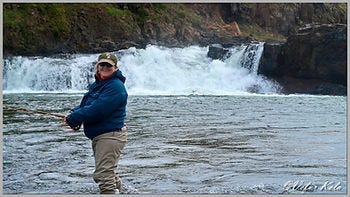
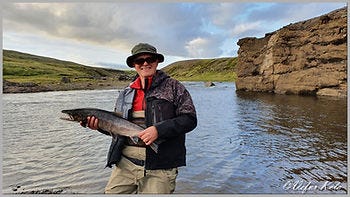
My spouse and I started at the top of the river at Hvassármót, Brúarhylur by Fornihvammur, and Klapparhylur. We didn’t see a sign of fish. At the fourth spot, located between Kattarhryggur and Kattarhryggsfoss, Guðrún landed a 6-pound, 69 cm salmon in Poka. With Króksfoss in the background, a salmon would have no trouble ascending the falls in these water conditions.
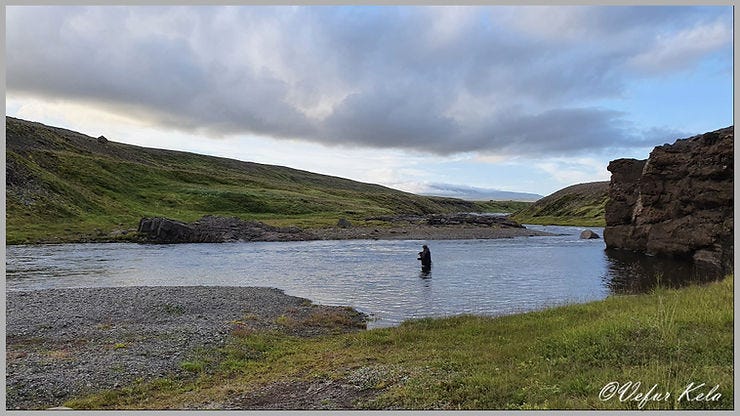
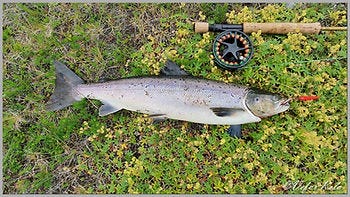
The next morning we started at Króksfoss and Poka. There is almost certainly always fish there; according to the catch log, 26 out of the 52 fish caught so far had been recorded in Poka. It’s best to fish these spots from the south bank, but that requires wading across. With the water levels so high, I actually had to hold onto my wife to make sure she didn’t get swept away. No fish were caught this time, so we tried above Króksbrú bridge next. Later in the trip, we spotted about six salmon below the bridge—not a spot where they usually hold. Perhaps the high water volume was the reason they were lying there.
Next, we headed to Neðri-Ferjuhylur, where we hooked a 3.5-pound salmon. Once again, it took a larger version of the Red Francis tube fly. We kept trying Ferjuhylur after landing the fish because there was still action in the water. Suddenly, I slipped and fell flat on my back into the river. I managed to scramble up after a bit of a struggle, only to slip again and dive face-first into the water. I rose again, soaking wet, glasses crooked, and my landing net gone. I eventually spotted the net on the riverbed and stumbled, drenched, back to shore.
I was taking off my wading jacket when, of course, a prime salmon jumped right behind me. I turned around, waded back out, and what do you know? I slipped a third time and went completely under. Luckily, it was warm out, so I stood up dripping wet and cast at the fish that had jumped. It took a swipe at the fly but didn’t hook, so we headed back to the lodge for a lunch break.
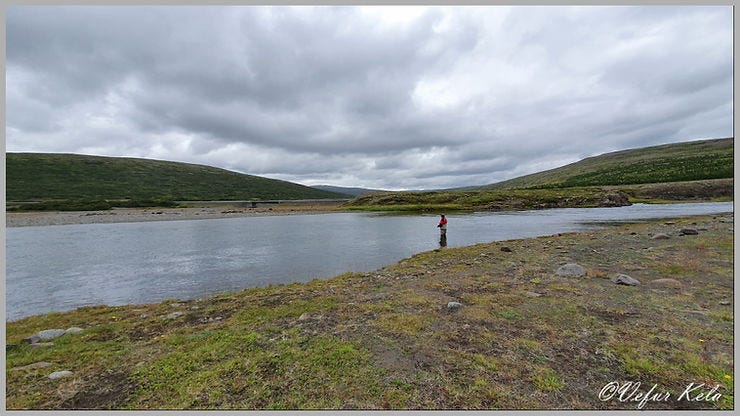
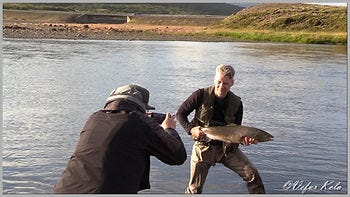
On Saturday’s evening shift, we fished the lowest beats. We started at Símastrengur—or what we thought was Símastrengur—though the spot seemed unlikely to us. Next were Hvammshylur, Beinhóll, and Snagafit, ending finally at Skógarnef, which is probably a spent spot by now. As we left Skógarnef, my wife spotted my brother-in-law, Maggi, at Ferjuhylur, where a salmon jumped. We decided to check on him, and there was no mistaking what was happening: he was in the middle of a struggle, playing a salmon that was clearly a big one.
The salmon turned out to be 12 pounds and 81 cm. The poor thing was quite shocked after the ordeal, and for a moment, I feared we might have to cull it, which would have been a shame. It took about three minutes for it to recover enough to swim away from the bank; it was a beautiful sight to see it swim slowly and majestically back into the current.
After that adventure, Guðrún and I headed down to Símastrengur—this time at the correct spot. There seemed to be no life there, nor in Hvammshylur. Actually, there were fish in Hvammshylur, but they seemed ‘reserved’ for Stefán, who landed two salmon from that pool. The larger one was around 8 pounds and was released in accordance with the rules.
On Sunday morning, our final shift, Guðrún and I returned to the uppermost beat and cast into the pool where we had caught a salmon on the first day. Once again, we hooked a nice fish. Guðrún wrestled with it for a while, but then it shook the fly and said goodbye. This time, it was the ‘Mýsla’ fly that had tempted it.
All in all, it turned out to be a great fishing trip. A total of eight salmon were landed: two from Ferjuhylur, two from Hvammshylur, one from the pool below Kattarhryggsfoss, one from the pool below Olnbogi, one from Poka, and the eighth was caught somewhere on the upper beat. Now the question is: will fishing in Norðurá become a permanent tradition?