
Originally written on Decemer, 20th, 2020.
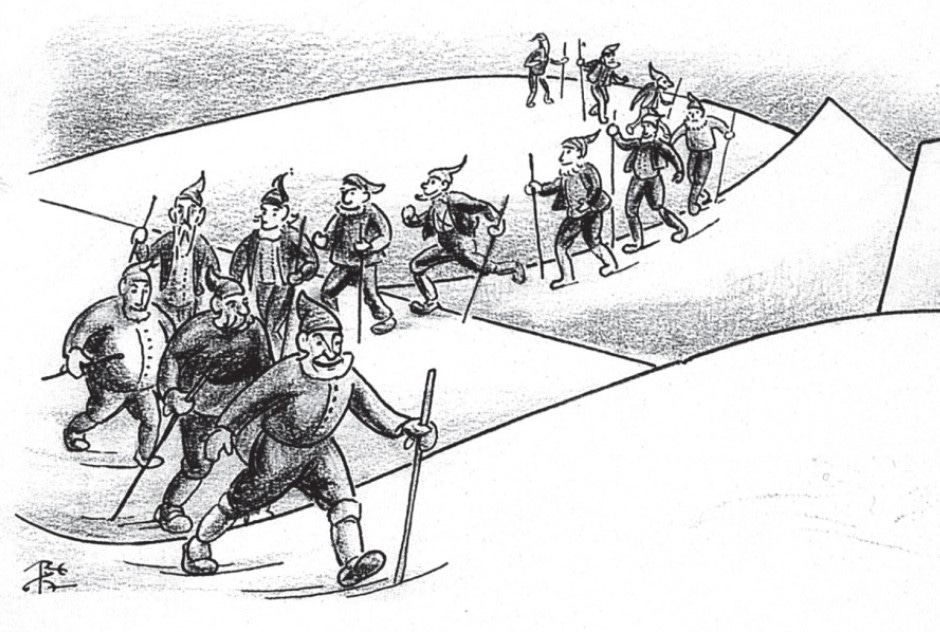
Every man, woman, and child in Iceland knows the lyrics about the nine Christmas lads and the tune it is sung to at Christmas parties every year. What the lyrics are about has always been a mystery, but now that puzzle is solved. Where, then, does the tune come from? Here, these questions are answered.
I don't remember exactly when I learned the lyrics to the folk song about the one and eight Christmas lads, but I was not old when it happened. Countless Christmas parties with the accompanying ring dance around the Christmas tree firmly planted the lyrics in my memory. To learn it, I drew pictures of its content in my mind. Soon, however, I began to question these lyrics. I thought they were, as indeed most people who read them do, somewhat strange.
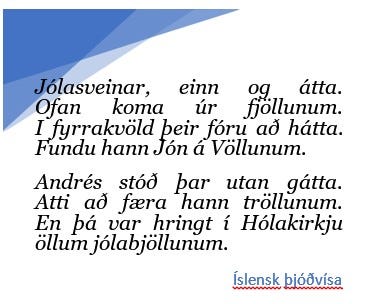
The first image that came to my mind was of nine white-bearded men with red pointed caps walking through the snow down steep mountain slopes on their way to inhabited areas. It surprised me that the Christmas lads were said to be only nine. I thought I knew for sure that there were thirteen. When Jón Arason collected stories from Icelandic folklore in the mid-nineteenth century, he found records of three groups of Christmas lads. One group had nine men, another thirteen, and the third eighteen. In fact, in records regarding Christmas lads in Icelandic folklore, one can find over eighty names of Christmas lads and also some names of “Christmas maidens.” It is probably best to agree on the thirteen Christmas lads that first appear in records around the middle of the eighteenth century. Furthermore, it is nice to have consistency between the number of Christmas lads and the days of Christmas.
Let us now return to the folk song. Its lyrics have always been a mystery, but now it is possible that historian Lára Magnúsdóttir has solved it. She found the solution in the Saga of Bishop Árni, which was written in the fourteenth century and tells of events that took place in the latter part of the thirteenth century. At that time, there were fierce conflicts between royal power and church power in many places in Europe. The King of Norway had recently gained power in Iceland. His emissary, Loðinn leppur, submitted a new law book in the name of the king for approval at the Althing. Nine chieftains were not pleased with this law book, and they sent one of their group to Norway to plead their case and deliver a letter to the king with their arguments. The man who went to meet the king was named Loftur. He had some difficulty getting an audience with Eirik Magnússon, the “priest-hater,” who was then King of Norway. The case of the nine men from Iceland was likely considered trivial because much was going on in Norway at the time due to disputes between the king and the church. “The nine Christmas lads” is probably a reference to these nine Icelandic chieftains.
The second image the child drew in their mind was of Jón the farmer at Völlur following closely behind the nine men. I actually always sang the lyrics wrong, because in my version, the Christmas lads were always ahead of Jón from Völlur. I also envisioned the Christmas lads making camp somewhere in the mountains the night before they came down to inhabited areas. In all likelihood, the lyrics of the folk song are referring to the fact that Loftur finally delivered the letter of the nine men at Jónsvellir in Norway, and that they went to bed refers to Loftur waiting to get an audience. These Jónsvellir are an area of land that was owned by the monastery in Bergen, Norway.
Who is this Andrés? The child, of course, pictured Donald Duck, as he was the main literary hero of my childhood. I always pictured him standing aside, watching the Christmas lads go by. The lyrics of the folk song do not, of course, refer to Donald Duck, but to Andrés Pálsson. This Andrés was one of the chieftains in Norway who fought against the increased power of the church. The Archbishop in Norway excommunicated Andrés. Andrés then died excommunicated in 1282 or 1283. The fact that he died excommunicated meant that his body could not enter a church, and he could not be buried in a churchyard. The child, of course, saw genuine Icelandic trolls come down the mountain slopes and snatch Donald Duck away as he stood watching the Christmas lads. His fate was, in other words, to be eaten by trolls. However, the trolls in the song do not refer to the monstrous beings that Icelandic trolls are, but rather to outlaws, and the chieftain was supposed to rest among them according to the church’s judgment.
The child’s last image was of a beautiful country church. The sound of the church bells echoed through the mountains when the Christmas lads came to inhabited areas, and the bells rang in Christmas. Reality was not quite so beautiful. People were not pleased that the fate of Andrés Pálsson was to be buried among outlaws, so they forced the body into the church. In that scuffle, it is said that one church pillar broke, but the intended goal was achieved. Andrés received a church burial, and the church bells were rung.
The English lyrics
The American lyrics of the song begin as a high-flown elegy. Clementine's lover seems to be mourning her death deeply. Soon, however, the lyrics sour, and humor becomes dominant. As early as the second verse, the focus shifts to the unfortunate girl's feet. Oversized feet, shoes made of boxes, and a splinter in her toe cause her to plunge into the river. The lover stands on the bank and refrains completely from trying to save her. Either the love did not run deep, or courage was lacking. Clementine drowns and is laid to rest in a graveyard where she fulfills her final role on this earth: to be fertilizer for the earth's vegetation. The miner, the girl's father, also dies and rests beside his daughter. At first, memories of the lover's caresses haunt him, but since she has become a decomposed corpse, he no longer deems it appropriate. He therefore begins courting his deceased lover's sister, and then Clementine is quickly forgotten.
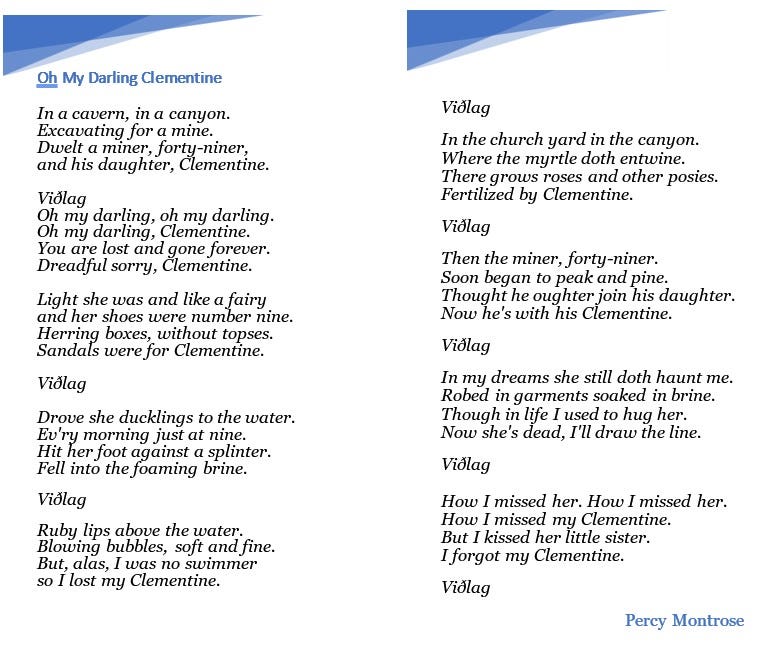
The lyrics are extremely bleak, and many things in them are on the verge of moral decency. For that reason, it is now hardly considered a suitable nursery rhyme. It is rather amusing that this song and lyrics have often been used in exactly that way. Many an American grew up with their parents singing these lyrics to them. I must say, the Icelandic lyrics are better. Although they were considered incomprehensible, they do not raise many moral questions like the American ones do. At least the images I drew in my mind as a child when I learned the Icelandic lyrics were very innocent. What images, I wonder, are drawn in the mind of an American child?
Be that as it may, it is believed that the lyrics, and indeed the tune as well, were composed by Percy Montrose in 1884. Whether he is the original author is not clear, because sometimes Barker Bradford, who published a similar tune and lyrics in 1885, is credited with the honor. Furthermore, the lyrics to the song “Down by the River Liv´d a Maiden” from 1863 by Henry S. Thomson are often pointed out as a possible influence. It is also possible that the lyrics were composed under the influence of a song that was extremely popular among Spanish miners at this time. That was the song “Romance del Conde Olinos o Niño,” which was a tragic love song. Those lyrics were composed by Gerald Brenan, a British writer who lived most of his life in Spain.
The Song
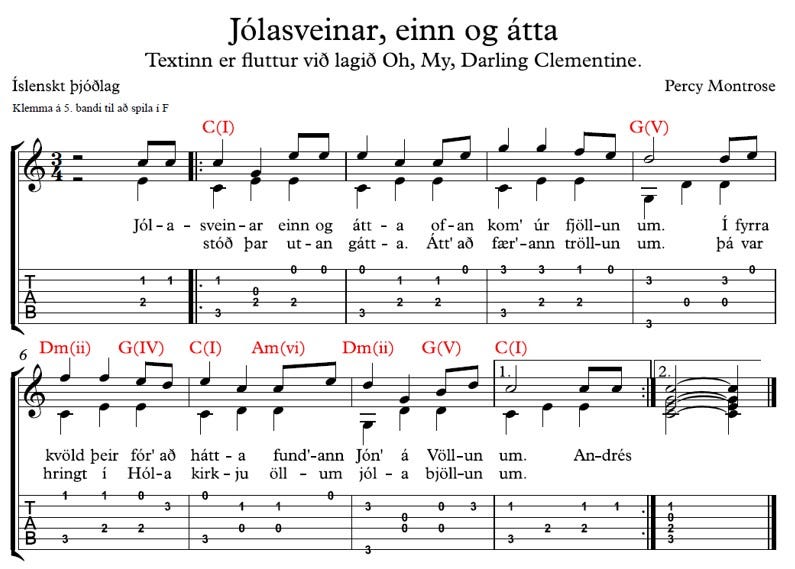
The song is an extremely simple composition. It is played in three-four time, and each verse is eight bars long. It is most often played in F major, but of course, the key does not matter because a key is just a key. Nothing is right or wrong in that regard. If the song is played in F major, it is sufficient to use three chords: F, C7, and Bb—the I, V, and IV chords of the circle of fifths.
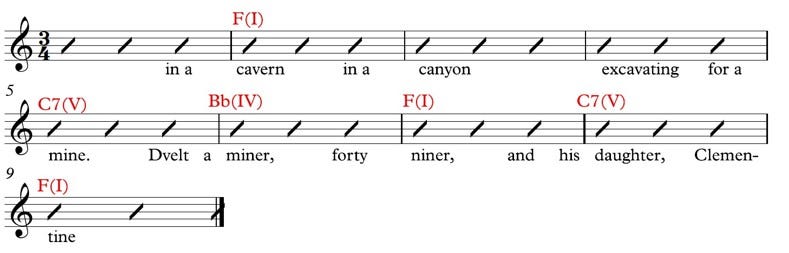
If you want to play the song using C major chord shapes while still in the key of F major, you place a capo on the fifth fret. The chords would then be C, G7, and F. Then, of course, the song can be played in various other ways. For example, by spicing up the chord progression and adding ii and vi chords in bars five, six, and seven, and playing the V chord as a major chord rather than a dominant seventh chord. This is how it would sound. The simple version first.
Sound samples
This song has traveled far and wide and been used on various occasions. For example, as a New Year's song for Jews and Chinese, as a military march for Germans, as a fight song for sports clubs and political forces, and last but not least, as a Christmas tree song at Icelandic Christmas parties. The song has often been heard in films and television shows, and numerous artists have made it their own. The first known recording is from 1942, performed by Bing Crosby.