

I have become completely convinced that playing scales is healthy and good, so now it is time to choose the first scale. Now the matter becomes difficult because scales await me, it seems, in endless rows. On which one would it be sensible to start? The omniscient World Wide Web gave me the answer.
Of course, I will start by learning the pentatonic scale because it is the oldest of them all. Probably over forty thousand years old. As evidence of this, there are old flutes made of vulture bones found in Germany. They were set up according to pentatonic scales. This scale is utilized in most types of music and is found in music from all corners of the world. It is the one that is used the most and, consequently, a very suitable scale to start with.
A traditional scale has seven notes, but the pentatonic has five. Intervals two and six in a traditional scale are omitted. For some reason, pentatonic scales work wonderfully when improvising over music, and most blues and rock guitar players rely heavily on this scale. Very many never take their scale exercises further, and that is just fine, but if the mind is set on jazz guitar or classical, then one must immerse oneself in traditional scales as well. Pentatonic scales, however, are very useful in blues guitar playing because one only needs to add an occasional “blue” note that gives the blues feeling. Most people start with the A minor pentatonic scale, so I will start my scale journey there.
The A minor pentatonic scale can be played in five positions on the guitar neck. Each position has its own pattern. Then you have to learn all the other scales in both major and minor. Certainly, this sounds overwhelming, but it is actually good news. When you have learned all five patterns and positions of the scale on the guitar neck, you actually know all the other minor scales because the patterns just move up and down the neck. Not only that. You also know the pentatonic major scales because their patterns are the same as in the A minor pentatonic scale, and the notes are the same. Except that the root is different. For example, the A minor scale and the C major scale are connected. If you intend to play a pentatonic C major scale, you just start on the C note. More on that later.
Pattern 1: A Minor Pentatonic Scale
The notes in the A minor pentatonic scale are A, which is the root, C, D, E, G. On the picture of the guitar neck, you see pattern 1 of the scale. Pattern 1 is played from the fifth fret.
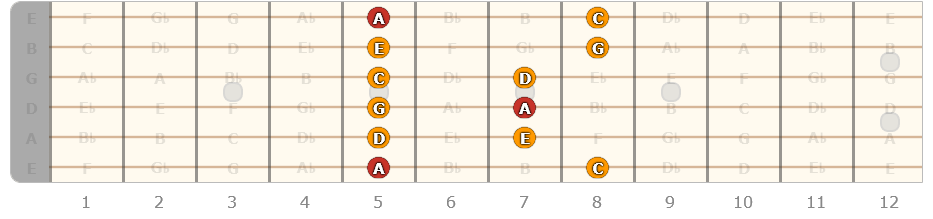
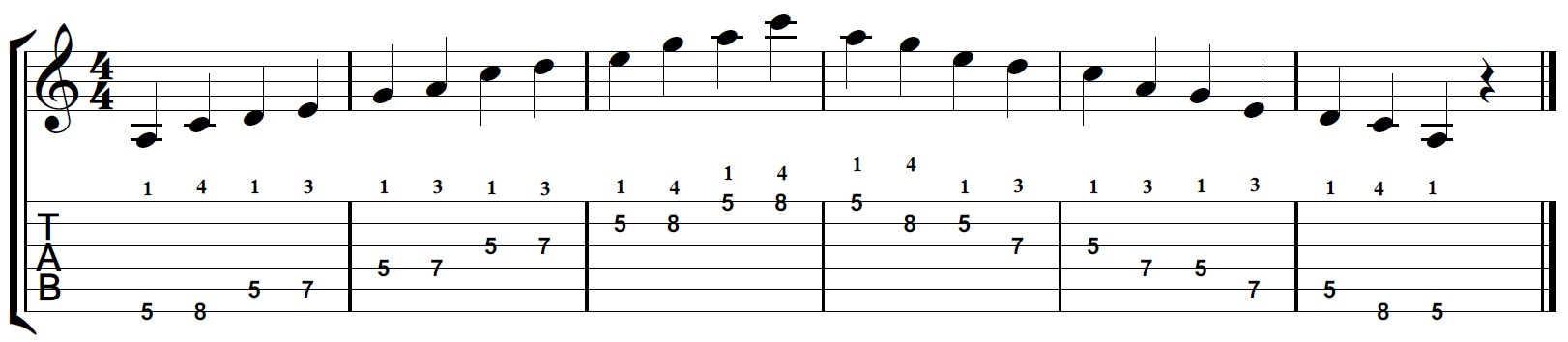
The intervals in the A minor pentatonic scale are 3 – 2 – 2 – 3 – 2. If the intervals are thought of from the root, they are A – C = minor third, A – D = perfect fourth, A – E = perfect fifth, A – G = minor seventh.
When do you use the pentatonic scale?
If you are playing a song in the key of A minor and intend to decorate it with a riff or improvisation, it sounds good to use the A minor pentatonic scale. The chords in the A minor key are: A minor B dim C major D minor E minor F major G major
Practicing the scale
The first rule is, of course, to practice the scale slowly and not increase the speed until you have managed to play it flawlessly ten times. Memorize the pattern. At the very least, learn where the note is that is the root of the scale. Start and end on the lowest root note. Practice the scale with the fingering as it is written above. Practice the scale also by using the third finger instead of the fourth on the thinnest two strings. This is to be prepared to bend the notes. Use a metronome. Here are detailed explanations on Justinguitar regarding the pentatonic scale. Here form 1 is taught on Justinguitar. He is actually teaching a solo over blues. Then you use exactly this scale but just add the blue note.
Now it’s just a matter of starting to practice.