
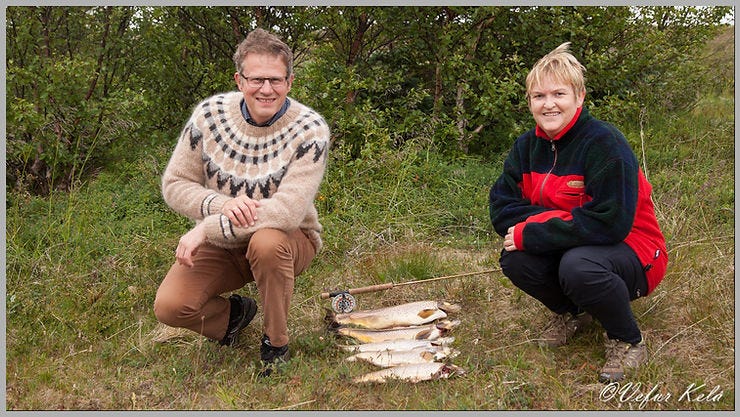
Shortly after I heard of the lake’s existence, I became interested in testing whether angling there was possible. I believed that if there was fish in the lake at all, it had to be possible to catch them with a rod. My first attempts gave no cause for optimism, but success has improved over the years. Over the August Bank Holiday weekend, I ran into the forestry farmer who owns the land today. He asked if I wasn’t going to try my luck in the lake this year. I said I intended to sometime in August. ‘By all means, do so—but drop by for coffee first and get the key to the gate,’ he said before returning to his fencing work.
When we arrived the following weekend, no one was at the farm, so there was nothing to do but hike up to the lake. This time it was just the two of us, my wife and I—no children and no dog. The walk took about an hour and fifteen minutes, and it is so much easier now that we can follow the track.
We decided my wife would start in Veiðivík (Fishing Bay), where the nets were set in the old days. I strolled over to Grunnavík (Shallow Bay) and fished its western side. We planned to fish our way leisurely westward along the lake. I have caught a fish in Grunnavík once and had a rise another time. Veiðivík has provided many a trout for the pots of those who lived on the farm, as that was where the nets were set. But none of them were caught on a rod. Once, many years ago, I noticed a fish in this bay when a handsome brown trout breached as it lunged after my lure. Legend had it that it was best to set the nets in Veiðivík following a southeasterly wind. The stronger the wind, the better.
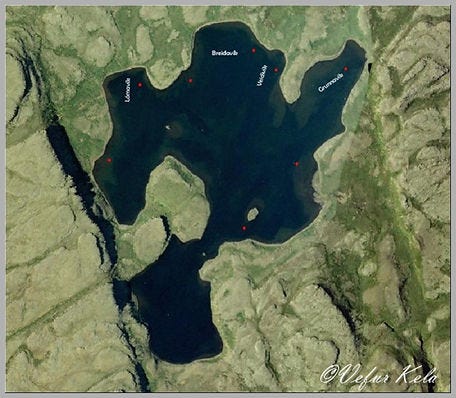
During this trip, there was a northeasterly wind that shifted to a pure easterly wind while we were fishing. I fished Grunnavík but saw no sign of fish. When I rounded the point between Grunnavík and Veiðivík to check on my wife, she had already landed a brown trout of just over two pounds. She caught it by casting along the shore, only about one and a half to two meters out. One doesn’t always need to cast as far as their strength allows.
The next bay over from Veiðivík is Breiðavík. I have never caught a fish there, but this time, right in the middle of it, my wife hooked a three-and-a-half-pound trout. She was completely outfishing ‘the old man.’ Both of these fish were females, full of roe. On our fishing trips, it’s a recurring story that my wife is filled with guilt and sympathy for the prey, especially if it’s approaching spawning time. On the eastern side of Breiðavík, we both noticed fish. Four times a trout followed my lure all the way to the bank, turning back with a splash of its tail after missing the bait.
The next spot is the one in the lake that has yielded the most fish on a rod for us. It’s on the bank between Breiðavík and Lómavík. Since I was still fishless, I was given priority at this spot. I decided to change flies and put on a snail pattern, as the first trout had been full of snails. My wife sat on the bank and watched. The snail pattern yielded nothing, so I decided to switch to something more ‘flashy.’ While I was changing flies, I heard her shout: ‘Wow, a huge fish just jumped five meters away from you!’ I neither saw nor heard the fish, but I cast a large Flæðamús (Marsh Mouse) with a conehead in the direction she pointed. I hadn’t retrieved more than fifty centimeters of line when there was a massive strike on the rod. A large brown trout had snatched the Flæðamús. I ran into a bit of trouble landing it because my leader was far too long, but it eventually ended up in the net and weighed in at five pounds.
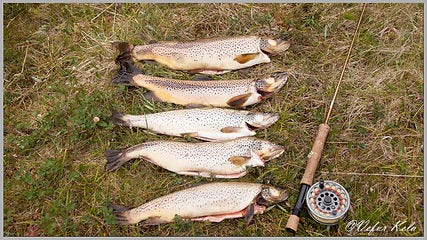
Shortly after, slightly further east on the same bank, my wife hooked a brown trout that weighed in at four pounds. I decided to stroll over to Lómavík and take a few casts there. It didn’t take many casts before I hooked a beautiful three-pound trout, which proved to be the last one of this successful trip. It was a tired but ecstatic couple that finally headed to bed after such a rewarding fishing excursion.