
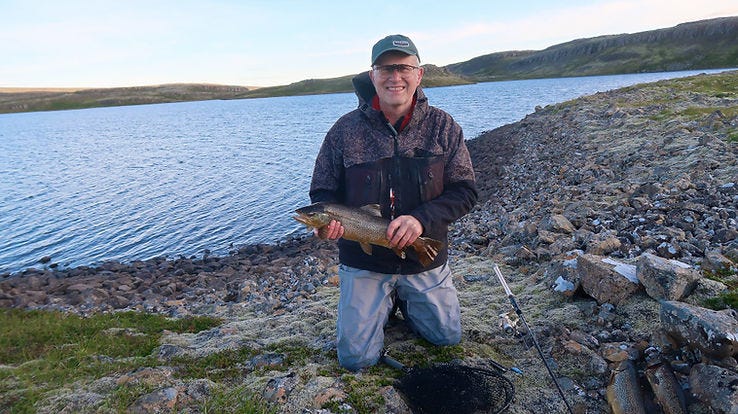
The construction at Brautarlækur has been a bit of a distraction this summer, but our house has finally reached a stage where we can relax. There is no urgent rush to finish the rest, so my wife and I decided that fishing and the outdoors would now take priority. The season for the moorland lake has arrived, so that was our destination this weekend. There is no road to the lake; the hike is entirely uphill, and since we’ve reached 'maintenance age,' we were a bit anxious about the trek. However, the conditions were all in our favor. The weather was wonderful—a northerly breeze that later shifted to the east. It wasn't too warm, just bright with a light wind.
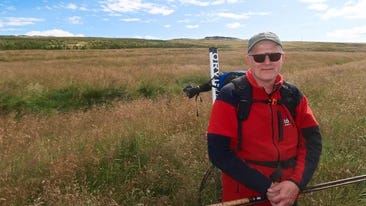
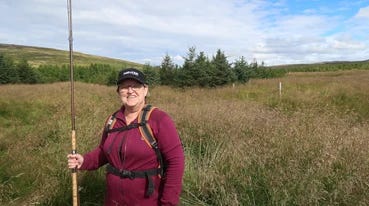
We were determined not to let our enthusiasm for fishing cause us to overexert ourselves on the hike. We walked slowly and steadily up the steep slope, resting several times along the way. As a result, we felt quite refreshed by the time we reached our fishing grounds by the lake. We started on the bank between Breiðavík and Lómavík. The name Lómavík (Loon Bay) is curious. Why on earth would it be called that? I suspect the explanation is simply that someone in the past misidentified the bird that actually 'owns' the lake: the Great Northern Diver (Himbrimi). Then there’s the other thing—why give the bay a bird's name when the bird itself is never seen there? We have never seen a sign of fish in that bay, and presumably, neither has the Great Northern Diver. That explains why neither we nor the bird have any business being there.
I left the fishing spot to Guðrún and walked west around the lake to the bank south of Lómavík and Breiðavík. I cast there for a while. Looking across the water, I could see Guðrún busy on the bank and suspected she had landed one. Then she waded out, and shortly after, I saw a splash; she had landed another. I, however, didn’t have a single bite. I then crossed Réttartangi and cast where the lake narrows into the South Bay. I saw no sign of the Great Northern Diver and wondered if something had gone wrong for him this summer. Just then, he popped up from the depths right in front of me and stayed with us from then on. The pair of swans is also at the lake, so everything on the moor is as it should be. There also seems to be plenty of ptarmigan, as a covey flushed from the brush on our way up. I saw no fish, so I strolled back.
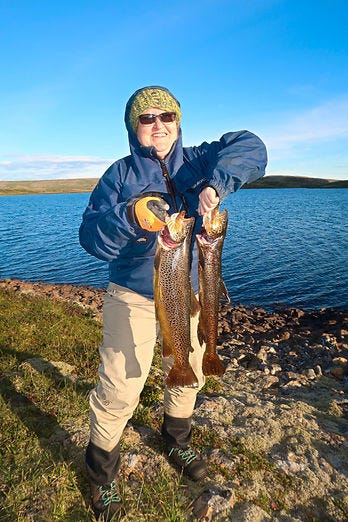
When I reached the spot between Lómavík and Breiðavík, my wife was lying flat among the tussocks, staring up at the sky. Not because she was exhausted, but simply because she was at peace with the world; she had already landed two brown trout. The first was about four pounds, and the second a bit lighter. The latter didn’t look well; it was quite thin and bore net marks, even though we thought there was no net fishing in the lake. Someone must have been poaching. I cast into the same patch where Guðrún caught hers and hooked a sizeable one, followed by another around two pounds. A third fish then took the line in Breiðavík—a four-pounder. In total, five brown trout ranging from two to four pounds were landed this trip.
We then walked back in the bright evening light and reached the house around half past eleven. We remarked to each other that it hadn't been nearly as difficult as we had expected. Perhaps the constant construction work over the past year has boosted our strength and stamina—and, of course, everything is easier when the weather is on your side.