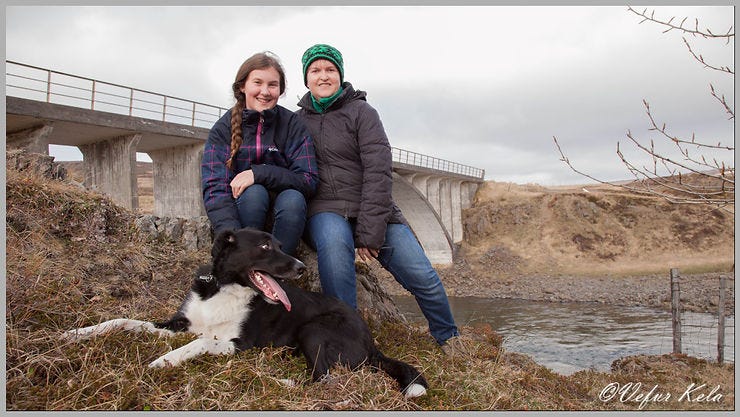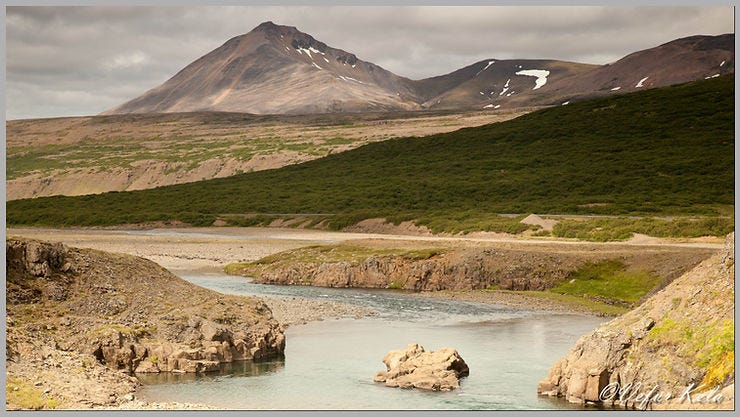
My wife and I were at Brautarlækur this spring, along with our daughter, Ingibjörg Lilja, and our dog, Lappi. It was our first trip to the summer cottage this season, and as school finals were approaching, studies were at their peak. Our daughter agreed to join us despite her heavy workload, provided she was given peace to study. We promised to keep quiet, but in a typical teenage lapse of concentration, her textbooks were left behind by the front door back in Reykjavík. She did remember, however, that one of her assignments for the weekend was to write a short story for Icelandic class. You don’t need textbooks to write a story. When she struggled to find a theme, Guðrún asked if she had heard about the ‘Tragedy at Einstakaklettur.’ Authors, after all, often draw inspiration for their stories from real-life events.
The incident took place during the time of Brynjólfur Bjarnason, the farmer at Krókur in Norðurárdalur and Ingibjörg Lilja’s great-grandfather. It was likely in the 1920s or 30s. The weather was as good as it gets in this country; the sun beat down on the household as they worked tirelessly mowing the fields below the farm. Modern mowing technology had not yet found its way to the upper reaches of Norðurárdalur. They mowed with scythes and whetstones, and sweat surely poured off the workers. At the end of the workday, a farmhand said he was heading down to the river to wash off. Brynjólfur warned him about the river; although the pool beneath Einstakaklettur looked tempting for a swim, it was dangerous because the water was glacial. He instructed the man to bathe only in the still water and strictly avoid the areas where the rocks cast a deep shadow over the pool.
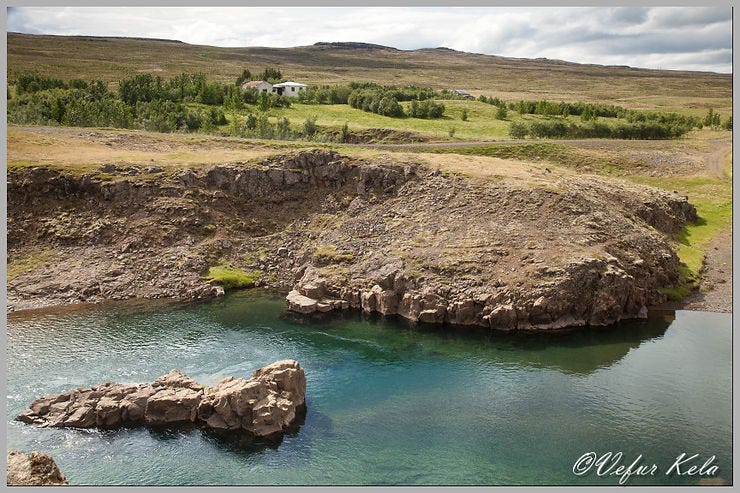
The farmhand never returned, and the household found him lifeless in the river when they went to check on him. Although there were no witnesses, the family believed he had leaped from the bank toward the rock into the deep pool, and his body simply could not withstand the shock of the freezingly cold water suddenly surrounding him. This incident weighed heavily on Brynjólfur, and the steps he took must have been leaden as he pulled the man ashore at Þrælavað—the shallows just below the pool at Einstakaklettur.
A link to an article written on the occasion of Brynjólfur's 70th birthday can be found here. It provides a vivid description of the struggles and hardships of farming life in those years. You can view it here.
This account of such a tragic event became the spark for our daughter’s story, which follows.
By Solitary Rock
The birds sang, and the sunbeams played upon everyone who stood clear of the shadows. I had worked from the first light of dawn and throughout the day while the sun was at its highest. Finally, my day’s work was done.
My hands were swollen from gripping the scythe I used to mow the fields; sweat trickled down my body, and every muscle screamed for rest. I walked across the mown grass toward the turf farm where the farmer and his wife waited for me to announce that my tasks for the day were finished. When I reached the farm, the farmer thanked me for my labor and granted my wish to bathe in the river, a short distance away.
The river flowed like a mirror through the valley. The sun glistened on the surface, and when I touched the water, it felt warm and refreshing. It was tempting to dive right in, but as the farmer had advised, I entered the pool slowly and carefully. At first, the water felt cold, but after a few moments, I began to adjust. I closed my eyes and let the river carry me along with its current.
I opened my eyes again when I felt a cold shadow fall across them instead of the sun. I tried to swim away from the shadow that made the river so freezing, but it seemed my body would not respond. I was trapped in the deepest pool of the river, in the cold shadow cast by Einstakiklettur—the Solitary Rock—which rose from the center of the water. I felt the cold creeping up my body, into every limb. I struggled to breathe, but I could not. Finally, the cold locked itself around my heart.