
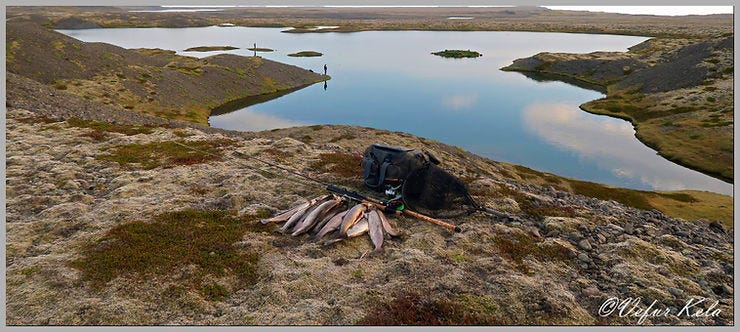
Like a persistent stalker, the fishing bug had started haunting me by mid-June. It was therefore a welcome relief when a fellow member of the woodworking club got in touch and asked if it wasn’t about time we made a run for “the unnamed lakes.” I certainly thought so, as it was the perfect way to kick off a long-awaited summer vacation—fishing in these fine lakes, far from the hustle and bustle of city life. For us pasty-white Icelanders, naturally adapted to damp chills and unpredictable winds, the weather forecast was terrifying: 20°C, dead calm, and sunshine. This time, three-quarters of the woodworking club’s fishing division were joined by one special guest. The fourth member of the club was busy elsewhere those days but followed along from the “electronic sidelines.” The guest is the brother of our club’s eldest member—the same man who first introduced us to these lakes.
The lakes in question belong to a cluster far off the beaten path, and for convenience, we have numbered them one through five. There are actually more of them, but these five are the ones we primarily fish. Having visited the area several times now, the lakes are starting to acquire names. What their official names are, we have no idea—if they even have any.
At the top of the cluster is Lake Number One. In our conversations, the lake has been dubbed “Arnarvatn,” because our friend Örn has twice had very memorable catches there. In this particular lake, it appears there are only resident trout—both brown trout and Arctic char—whereas in the other lakes, the fish can move between them. My cousin and I began fishing in Arnarvatn during the first shift. Just as we were gearing up—or so I thought—my companion swung his backpack over his shoulder and announced he was going to walk to Lake Number Five. That lake is at the bottom of the cluster and is quite a distance away. He flatly refused to take the car and headed off on foot, claiming it was only a fifteen-minute stroll. He is certainly a great hiker, but if that walk took fifteen minutes, he must have been wearing seven-league boots. As I was assembling my rods, I realized my light Shimano spinning rod was broken. I had completely forgotten that I’d stepped on it and snapped it in that exact spot two years earlier and bought a new one. That new rod was at home in storage, while the broken one had come along for the ride. I had to make do with my old Hercon rod, though the Shimano is undeniably more fun for trout.
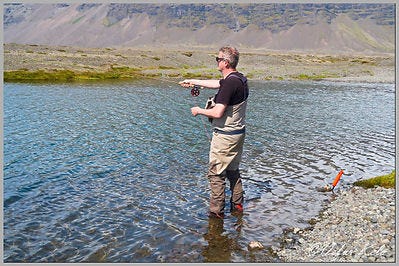
Mindful of the fact that the lakes had yielded fish on the fly last year, I began by casting toward the shallows in the northwestern part of the lake that my friend Örn had discovered a year ago. Experience had taught me that fishing near the bottom was most effective, so I rigged my fly rod with a slow-sinking line and a short leader. I opted for a bead-headed Peacock fly, and on the third cast, a two-pound brown trout took it. On the fourth cast, another one struck. Things quieted down for a while after that, so I cast out some bait, intending to let it sit while I continued to work the fly. It turned out to be quite a restless endeavor, as there was a constant bite on the bait. When all was said and done, I had landed three or four trout on the fly, but in total, I hauled twelve trout back to the car when the shift ended.
Around nine o’clock that evening, the brothers visited me at Arnarvatn. They had spent the day at Lake Two and Valla-lake (Lake Number Three). They were in rather low spirits, having only landed four fish between them. In the distance, we saw my companion and cousin, back in his seven-league boots, trekking along the ridges above the lakes. He was making great time despite carrying a considerable load. He had found fish in Lake Five off a point on the southern bank—and plenty of them. He landed twenty fish right there by the point.
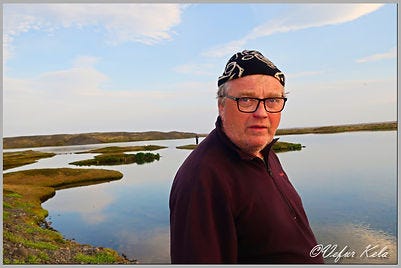
My cousin and I began the second shift at Lake Two and Valla-lake. I let the bait sit in Lake Two while I cast my fly far and wide across the lake, as well as in Krakkavatn and the smaller ponds nearby. This time, I had plenty of peace for fly fishing, as there was clearly very little fish in the lakes, and I ended the shift empty-handed. Meanwhile, my fishing companion spent his time at Valla-lake and managed to scrape together a few fish, though they were not many. All the while, the brothers were fishing Lake Five and didn't show their faces until evening. When they finally appeared, they walked with a bit more swagger than after the first shift, as they had over thirty trout in tow.
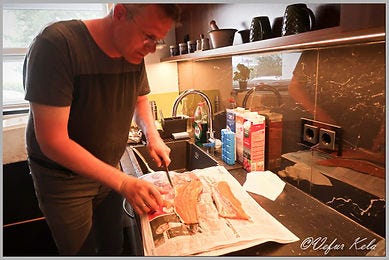
For the third shift, my cousin and I went to Arnarvatn. He fished the shallows where I had been the day before, while I walked out to a point in the middle of the southern part of the lake. I’d had good luck there previously. This time, there was plenty of fish off the point, and by the end of the evening, I had landed thirteen brown trout, several of them on the fly. The fly fishing actually got off to a rocky start, though. I tied a red Nobbler to the leader, and the trout were clearly interested. Finally, one hooked on, but just as I was reaching for the net, he vanished. The knot had come undone. I tied on another red Nobbler, and there were repeated strikes, but I couldn't seem to hook a single fish. I wondered if the trout were biting too tentatively, so I decided to switch to a fly without a tail. One thing didn't seem to support that theory, though: the takes. They were quite aggressive. When I finally got the fly back in my hands, the cause was revealed. There was no hook on the fly—it had snapped off. I switched to a "Þingeyingur" and landed several trout on that. Meanwhile, my cousin was fishing well along the northern bank.
The day was drawing to a close, and over the chicken soup my cousin had brought, we took stock of the situation. The group was worn out after three shifts of fishing in clear skies, 20°C heat, and dead calm. One morning shift remained, and the woodworking club’s “Excel man” informed us that breaking the club’s fishing record was within reach. On the final shift, each fisherman would need to land four trout to break the record. My cousin and I headed to Lake Five, which should perhaps be named “Stóravatn” (Big Lake) as it is the largest of the bunch. Just northwest of it lies Lake Four, which from now on shall be known as “The Useless Lake.” Not that it’s completely useless—we have caught fish there—but it’s just not as enjoyable to fish as the others.
It remained warm and bright, but now a gale-force wind had picked up, making fly casting directly into the wind difficult, to say the least. I switched to a 12-gram lure, which was easy to cast in the wind, and landed four trout with it. Among them was the only Arctic char I caught during the entire trip. So, I had landed my required four fish. My cousin landed eight, so things were looking good for the record. The brothers landed four fish between them, so the record was broken—or was it? Somewhere the math had failed us; despite landing sixteen fish on the last shift, the trip ended with a total of 122 trout. We would have needed just one more to break the record. Personally, I landed 29 trout, all weighing between one and two pounds.