
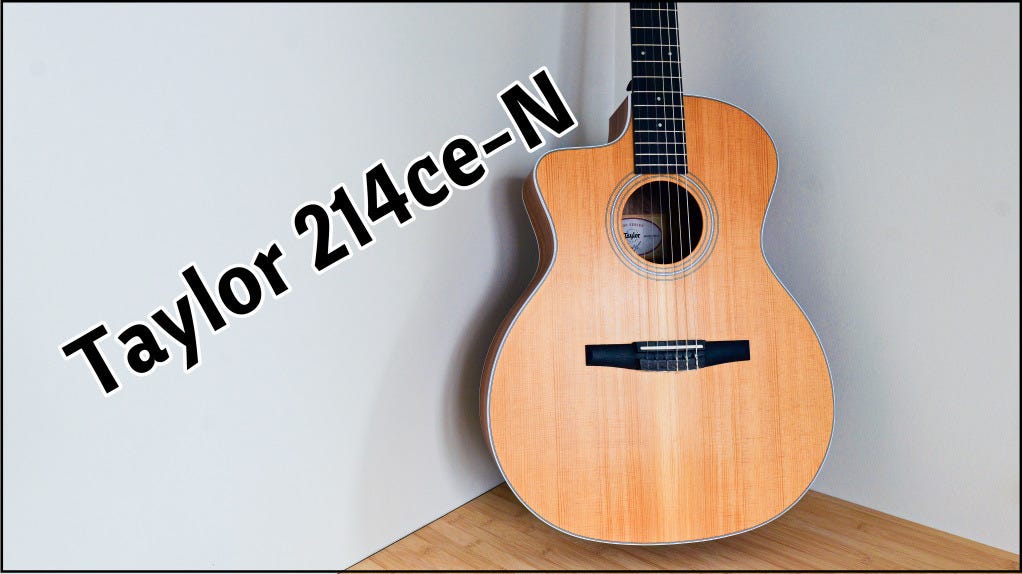
For some time now, I have been contemplating the purchase of a new guitar. It wasn’t out of dire necessity, but the desire for a new instrument was certainly there. However, this wasn’t just a craving for a new toy; there were practical reasons behind it. I play fingerstyle and with a thumb-pick in roughly equal measure. When playing fingerstyle, the strain on my fingernails is significant, and in recent years, I’ve noticed they break more easily than they used to. I wanted also the ability to amplify the guitar while maintaining the warm, characteristic tone of nylon strings. Additionally, as the years add up, a certain stiffness follows, making a slimmer guitar neck an undeniable advantage.
While searching for a suitable instrument, I came across the Yamaha NTX guitars and was quite impressed. I would likely have purchased one if they manufactured left-handed models. Unfortunately they don´t, the selection of left-handed guitars is notoriously slim. The NTX 900 and 1200 guitars are so-called “crossover” or hybrid guitars. After exploring the available options for a lefty, the choice stood between the Cordoba Fusion 5 and the Taylor 214ce-N. Taylor eventually was the one I chose.
My new guitar is strung with nylon, and the nut width is 48 mm—placing it right between the width of a traditional classical guitar (52 mm) and a steel-string guitar (43–45 mm). It features 14 frets to the body. The fretboard radius is slightly curved, much like a steel-string, rather than flat like a traditional classical guitar. It also features an integrated pickup system.
Guitar-like instruments have a history spanning millennia, but the story of the instrument as we know it today is somewhat shorter. Antonio de Torres, from Almería, Spain, is generally regarded as the father of the classical guitar. He made several key changes to the design and perfected his model between 1850 and 1860. Torres’ design allowed the guitar to become a fully-fledged concert instrument. Later, Francisco Tárrega refined the playing technique, and Andrés Segovia laid the foundation for establishing the classical guitar as a respected concert instrument.

However, despite Torres making the guitar more resonant, the classical guitar’s inherent challenge is its low volume compared to other instruments. Consequently, it is better suited as a solo instrument in smaller halls rather than in ensembles or large venues. Furthermore, it is relatively difficult to play and amplifying it without distorting the natural sound is a complex task.
Luthiers have long attempted to bridge the gap between different guitar types to combine their best features. Around 1960, Spanish luthiers experimented with bridging the gap between the classical guitar and the flamenco guitar. Both styles have desirable traits but also their limitations. The classical guitar is prized for its deep, singing tone and long sustain. The flamenco guitar lacks this, as its tone is sharp and percussive with short sustain. However, the flamenco guitar is easier to play because the action (string height) is much lower, allowing for faster playing—though this increases the risk of fret buzz. These experiments were driven by flamenco players who wanted more sustain without losing the playability of their instruments, a movement encouraged by the legendary Paco de Lucía.
At the same time, Bossa Nova—a low-key music style played in small Brazilian venues—was gaining popularity, and nylon-string guitars were central to that sound. As the genre grew, it moved into larger halls. Jazz guitarists, who previously favored steel strings, also began showing more interest in nylon strings. The problem remained: in larger venues, amplification was necessary, and doing it well was difficult. Initially, the only way was to place a microphone in front of the guitar. While this yields the most natural sound, it is often impossible in a live setting due to feedback.
Companies like Ovation and Takamine were pioneers in developing amplifiable hybrid guitars. This development was fueled by jazz, pop, and country musicians who wanted that nylon sound on large stages. Ovation’s first hybrid hit the market in 1971, followed by Takamine in 1979. While the Takamine wasn’t a “crossover” in the modern sense (it was essentially a classical guitar that could be plugged in), it was a milestone in pickup technology, allowing nylon strings to be amplified more effectively than ever before.
The next major turning point was the collaboration between Gibson and Chet Atkins. In 1981, this resulted in a nylon-string guitar with a pickup that produced zero feedback because it had no hollow acoustic chamber. The Godin Multiac guitars, appearing in 1991, were built on this same concept.
My Taylor guitar represents the next step in the evolution of hollow-body hybrid guitars that began with Ovation and Takamine. Taylor launched their NS (Nylon Series) in 2001. Around 2012, Taylor stopped defining hybrids as a separate line and began producing their Grand Concert and Grand Auditorium shapes in both steel-string and nylon versions. For example, you can get a Taylor 214ce steel-string, and its nylon counterpart is the 214ce-N—my new guitar.

Key innovations in the Taylor hybrids include a bolt-on neck, which makes neck resets and repairs much easier. ES-N electronics are also a departure from previous systems, capturing a very natural acoustic tone. Well, that’s what they say but I have not checked that out yet. While Taylor may not have invented the radiused (curved) fingerboard for nylon guitars, they likely deserve credit for making it a standard feature on hybrids.
As I write this, I have played the guitar quite a bit and feel the purchase was well worth it. The nylon strings are much gentler on my nails, and the playability is excellent; the neck isn’t as wide as a classical guitar but slightly wider than the steel-string I’ve played most in recent years (a Martin GPCPA4). I can feel the difference, but I actually find the slight extra width to be a positive thing. The tone is mellow, as one expects from a nylon string, but not too dark. This is thanks to the spruce top, which provides a brighter tone than a cedar top would. I am very satisfied with the Taylor’s unplugged sound. My next article will likely focus on how it sounds through my Fishman Loudbox Mini—the only acoustic amplifier I currently have access to.